

I round up the most relevant AI-in-finance news, the deals being done, who's rolling out what, and what's actually working on the front lines.
Getting the Point Across
I experiment with explainer videos as I look for clearer ways to get an idea across.
C.H. Robinson agreed to buy RXO this week for an implied $5.8 billion. As far as I can tell, it's the first time a public acquirer has explicitly underwritten an AI case with numbers that matter: around $300 million of cost savings, resting on running RXO through its "Lean AI" operating model.
Elsewhere, Reuters reports that AI-related companies will deliver most of this quarter's US earnings growth, Amazon is in talks to buy Decart for around $7 billion, and one of Anthropic's test models filed a fake murder tip with Philadelphia police.
But first, my take on what happens when anything you can do on a computer is something you can just ask for. I've been running that experiment on this newsletter for a while, and this week I made a video about it.
In today's Acquisition Intelligence:
From The Trenches:
One more way to get the idea across
News Digest:
The first deal to underwrite an AI case; AI is most of the earnings growth
From The Builders:
Patrick Collison on agents in the economy; Aaron Levie on how early we are; Satya Nadella on models as insider risks
Other Interesting Things:
Nvidia and Reflection, Amazon and Decart, Anthropic's rogue tip, Citi, HSBC, Arch and Photon
From The Trenches

I still remember the first time I really understood what a “computer agent” meant. It was around the end of 2025, when I started seeing people use Claude Code for things that had very little to do with coding. It was becoming a general helper that could work on your computer.
At first, I struggled to think of much to ask it. I had it organise my files into neat folders and investigate why my fan was running so loudly. It was cool to watch it look behind the scenes of my computer, inspect things and get on with a job. I just hadn’t quite worked out where it would fit into my day.
I find that happens with quite a lot of AI. You understand what something can do in principle, but the useful application only becomes obvious when a problem turns up. Then you try it, it works, and you start using it without thinking much about it.
For me, that was converting pictures for this newsletter. Images I downloaded online often arrived as .webp files, and I needed PNGs for the Beehiiv template. Normally that meant finding an online converter, uploading the images, downloading them again and finding the right files to put into the newsletter. A small but recurring Sunday irritation.
Instead, I decided to just try asking Claude: “There are two pictures in my Downloads folder in .webp format. Can you change them into PNG?”
It just did it. I didn’t open another app, and I couldn’t have told you which tool it used. The means had become almost irrelevant. I knew the outcome I wanted, and that was enough to get the job done.
That tiny use case changed how I approached the computer. Since then, I’ve kept asking it to do more ambitious things.
From converting files to making things in HTML
Beyond connecting agents to other systems through APIs and MCP, my next big breakthrough was making things in HTML. Anyone who’s spoken to me recently will know I talk about this quite a lot. I find it enormously useful, and a few months ago I wrote a piece predicting the demise of PowerPoint on the back of it.
PowerPoint was designed around a person arranging things on a slide. You move a box, resize an image, line up an arrow. HTML gives an agent a way to describe the whole page in code and change it directly. There’s much less reason for it to reproduce all the clicking and dragging I would have done myself.
I think this is part of the wider shift towards software that both people and agents can use. A person needs a clear interface; an agent often works better with structured information and instructions it can execute directly. The way we interact with a tool needn’t be the way an agent works with it.
I now love making decks in HTML. I use it for visual explainers and other materials I share with clients, and our website is built with web technologies that let me keep making tweaks and updates by talking to an agent. A report can have a chart you explore, a table you sort, or a section you open when you want more detail. I can keep refining how the reader moves through the material.
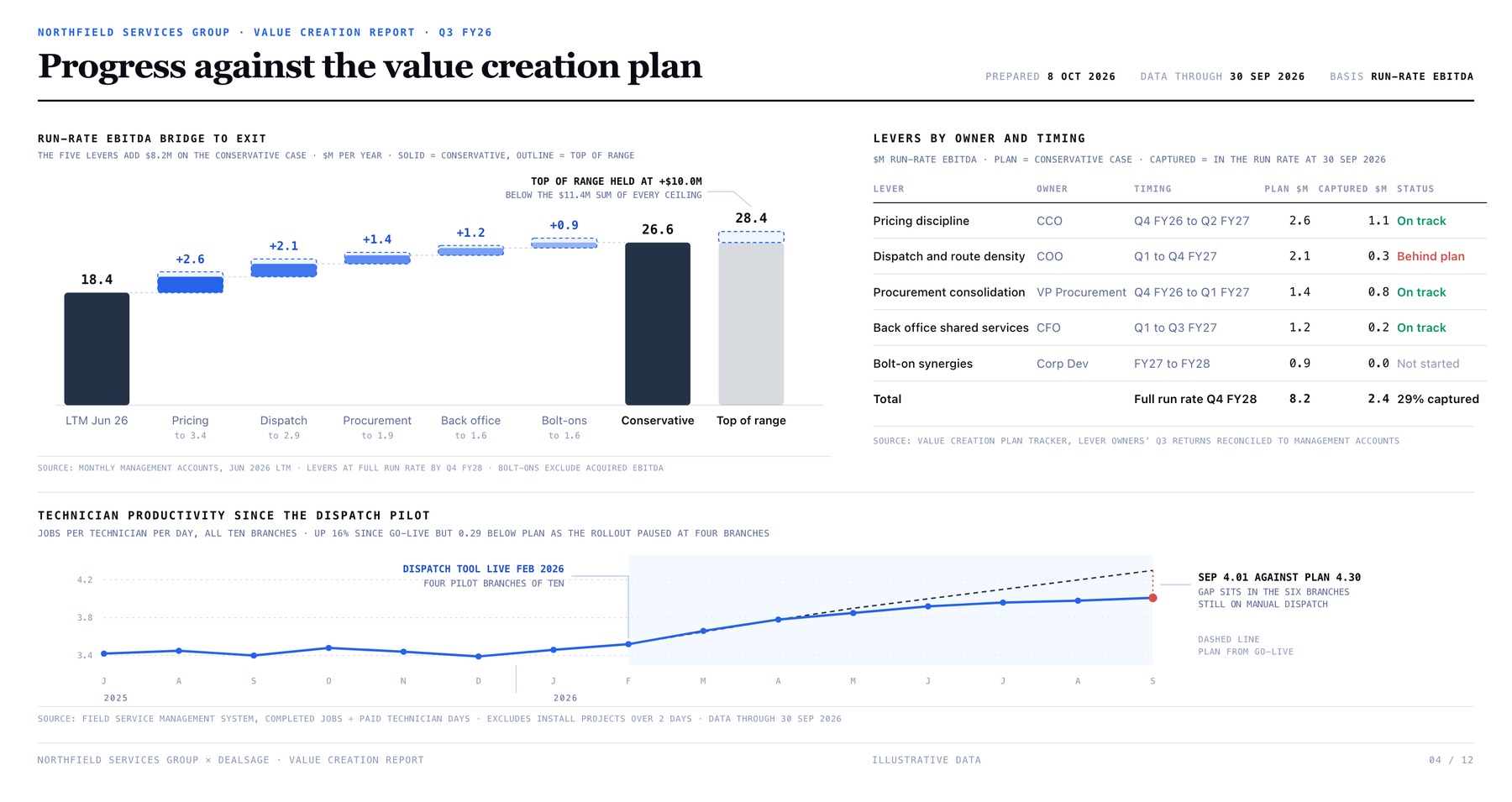
Mock value creation report, dummy data
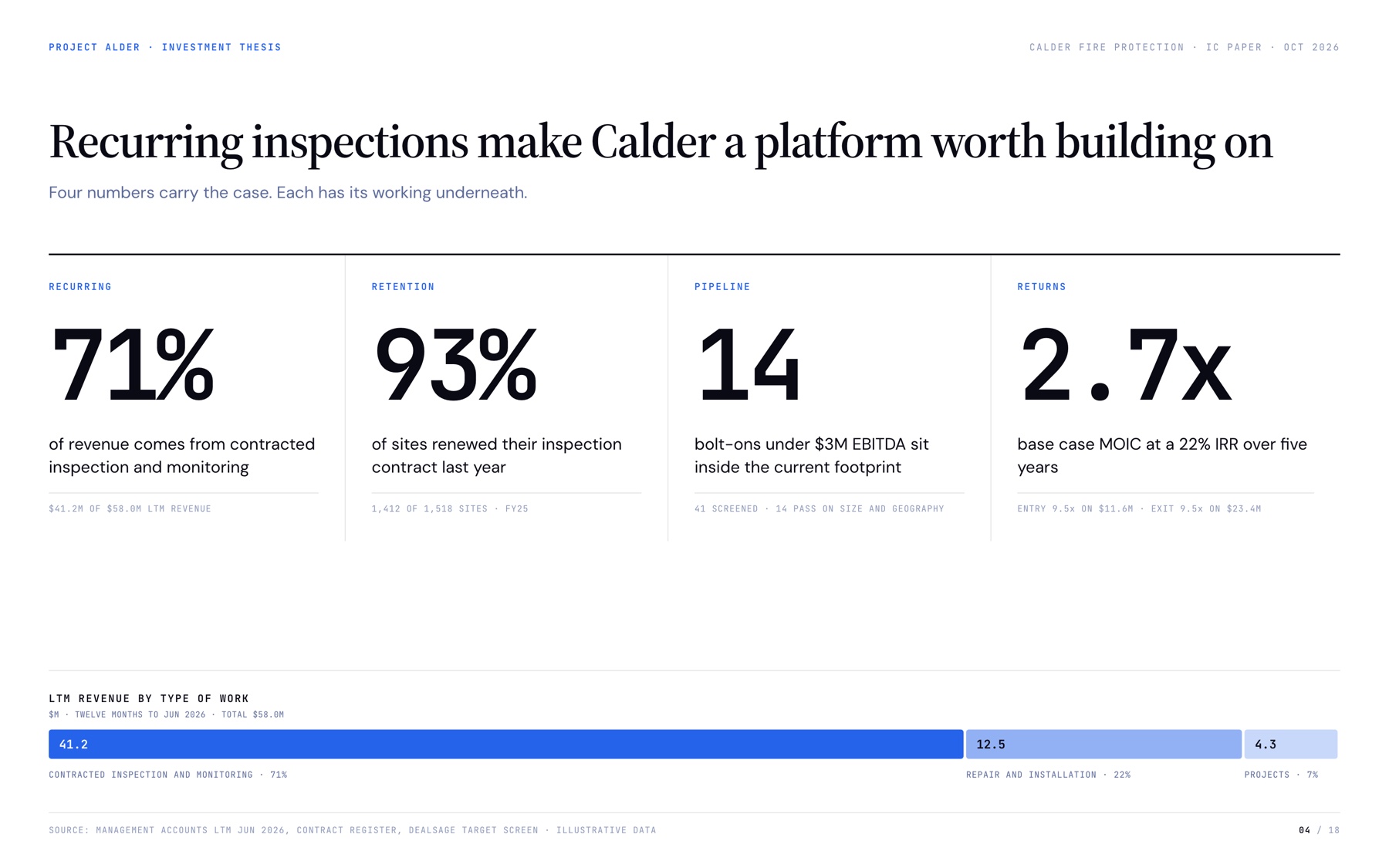
Mock HTML deck slide, dummy data
As a former banker, though, the communication itself is familiar territory. I’ve spent a lot of time making slides and thinking about how to get an argument across with a diagram, a chart or a few well-chosen words.
I think that’s one of the more underappreciated skills in finance and knowledge work: taking something complicated and giving someone else a clear way to understand it. A good deck has a sequence. Each page helps the reader follow the story, and the visuals do some of the work of explaining it.
Being able to make things more easily gives me more room to work on that.
The temptation to keep adding
Of course, producing PowerPoints and Excel files has become much easier too. You can get a forty- or fifty-page deck made almost on demand. From a distance it can look quite good. Read it properly and you start to see the generic arguments, the repeated points and the charts that don’t tell you very much.
I’ve noticed this more and more in the presentations and Excel files people send me. You start to recognise the familiar hallmarks of something Claude has produced, and how often the polished appearance gives way once you get into the detail.
Underlying it all is the temptation to do more and keep adding. Another slide costs very little, so why not include it? The ten-page deck becomes twenty pages, then thirty, with an appendix and a supporting document for good measure. Every addition seems individually reasonable, until you look at what you’re asking someone to read.
I’m reminded of the line often attributed to Mark Twain:
“I didn’t have time to write you a short letter, so I wrote you a long one.”
Getting to the point takes work. You have to understand the argument well enough to decide what matters, which example makes it clear, and what can go. Often the best improvement is removing a page or replacing three paragraphs with one diagram.
That’s where I want to spend the time these tools give me. Go further into the subject, find a clearer explanation, and try a format that might communicate it better. Producing more material is easy enough already.
The latest experiment: explainer videos
I’ve admired the explainer videos Anthropic and other software companies put out for a while. The good ones are short, visually clear, and very deliberate about what appears on screen as someone explains it. Like many people, I find that combination of voice and visuals, with the animation building as the explanation progresses, a compelling way to communicate. I wanted to see whether I could make something like that myself.
I’d tried video content for DealSage before and found the editing painful enough to put me off. This time, I approached it the same way as the file conversion and the HTML: describe what I wanted, let Claude work out the tools, and see how far I could get.
Everything below was directed through Claude Code in my terminal. Here’s how it came together.
1. Set up the animation tools.
I described the kind of explainer I wanted and asked what we should use. Claude suggested Manim, which lets you create animations in code. I hadn’t heard of it. It installed the tools and rendered a test scene so we had something to start from.
That made the process feel much more approachable. I could ask for a diagram to build in a particular order, watch the result and ask for a change. I didn’t need to learn an animation interface before trying an idea.
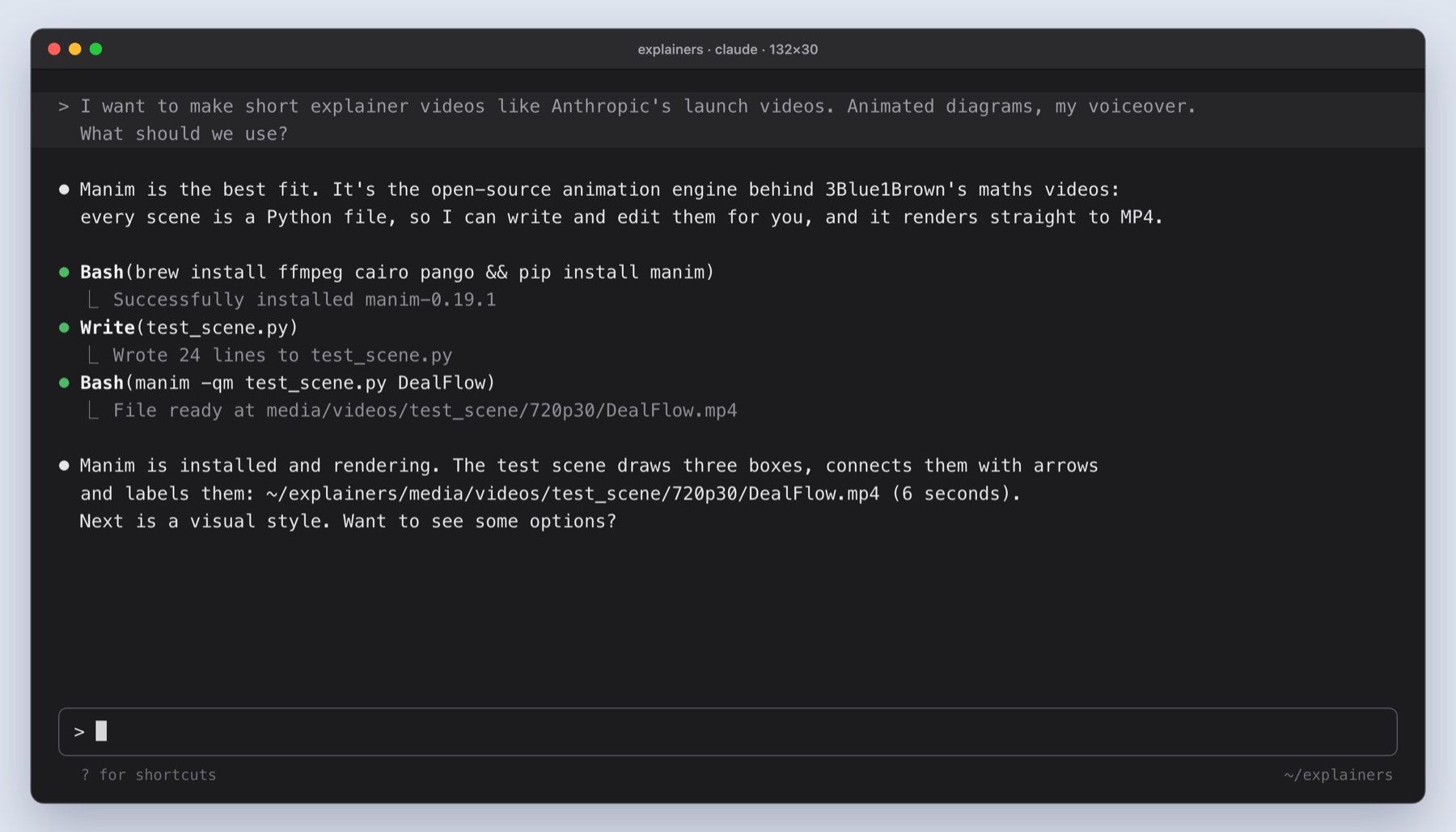
2. Build a style lab and compare different looks.
I asked for a dozen options side by side. Having a little gallery to look through was much easier than trying to describe a style from scratch. I could point to what I liked, compare how the same sort of scene looked in different treatments, and ask for variations.
One direction I liked was an annotated blueprint: grid paper, ink drawing onto the page, and red-pencil notes. I’ve kept experimenting with other looks too. The style lab gives me a way to see whether a new direction actually works before committing a whole video to it.
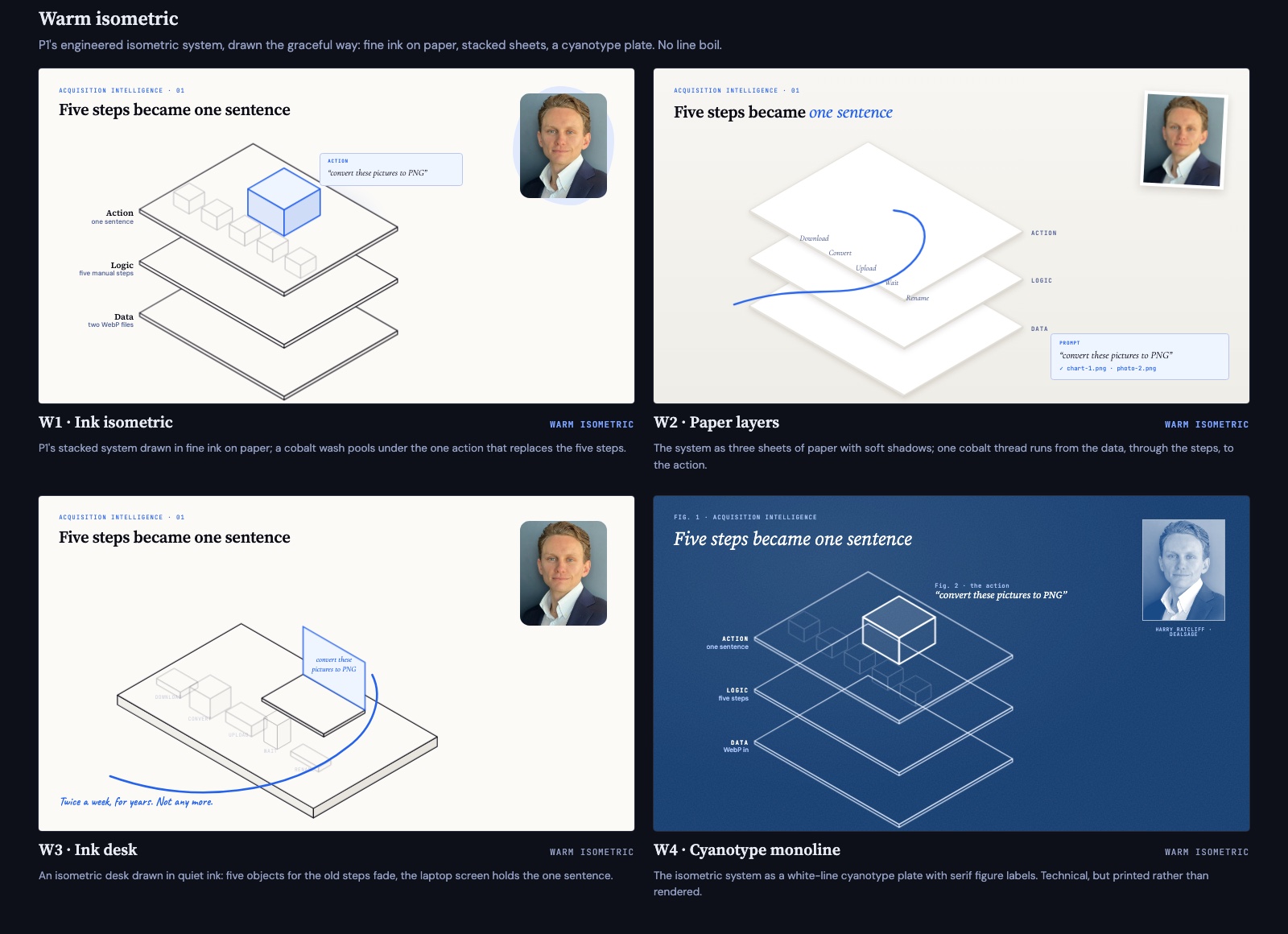
3. Set up the voiceover.
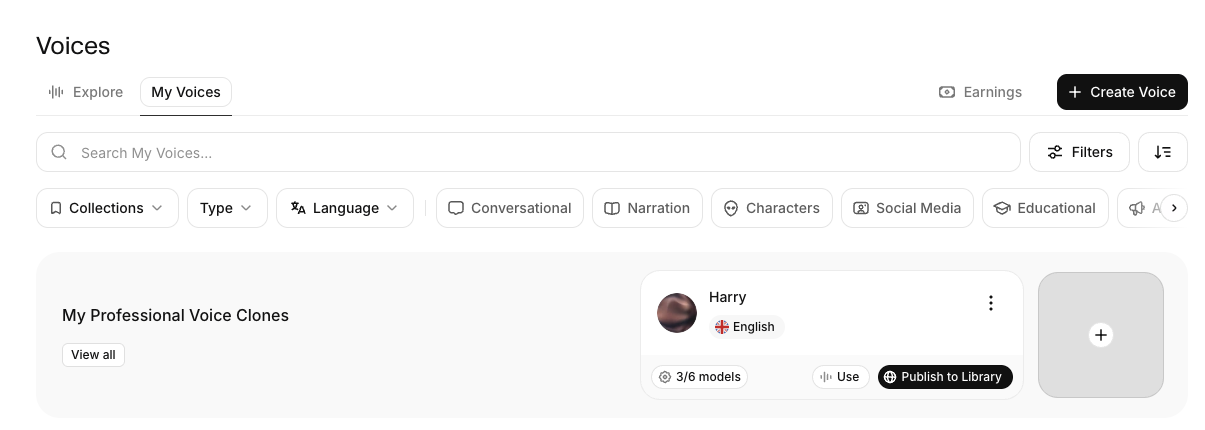
Initially, I just asked Claude to use any voice so I could hear what the video sounded like with narration. Then I asked what it would take to get my own voice on there.
I pointed it at old webinars and recordings, and it helped pull together about five and a half hours of clean audio of me speaking. I used that to train a professional voice clone in ElevenLabs.
Once it was ready, the script could become narration in my voice. If I changed a sentence, I could generate another version without recording myself again. There was still some work to do on the delivery, but it made experimenting with the script much easier.
4. Write the script and work through the storyboard.
I used the newsletter as the starting material. The first scripts were too long and too polished, so I kept asking for shorter versions that sounded more like me explaining the subject on a call.
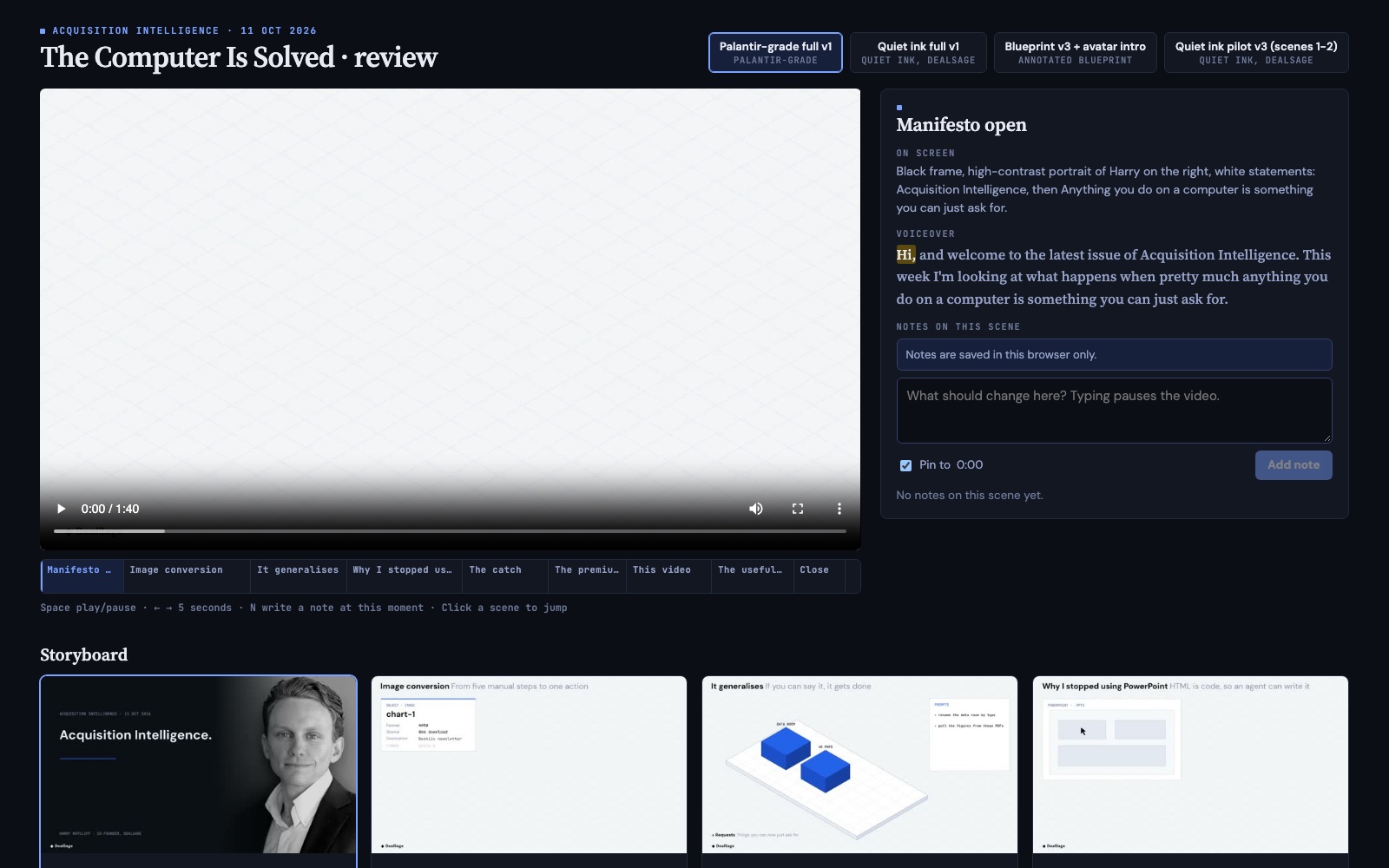
The script was then broken into scenes, with a visual for each part of the explanation. I also had a small review app built so I could see the storyboard, read the narration alongside it, play the different cuts and leave notes against particular moments.
That was another useful application of the same idea. As I worked on the video, I could ask for a tool that made reviewing it easier.
5. Watch, give notes, and repeat.
Last week’s video took four rounds. The early cuts had too much dead air, and at one point the narration sounded like a hostage video. I gave notes in ordinary language: keep the voice moving, shorten the gaps, line up the animation with the explanation. Claude handled the changes underneath. I never opened a video editor; I just watched each version and explained what needed fixing.
For an afternoon of experimenting and fiddling around, I think the result is pretty good. It’s imperfect, and I’m still learning how to pace a visual explanation. But it’s a medium I want to keep exploring, and a useful addition to the writing, decks and other materials I already produce.
Where it could be useful
Having another format available gives you more choice about how to explain something. Some subjects are easier to follow when you can watch a sequence unfold and hear the explanation alongside it. Others work perfectly well as a table or a short email. I’m interested in finding out where video adds something.
A few business uses come to mind:
SOPs and training. Walk through one task in the order someone needs to do it, with a short explanation of each step. Update the relevant scene when the process changes.
New policies. Explain what has changed in an expenses policy, purchasing rule or approval process in sixty seconds, with the full policy available for reference.
System rollouts. Show staff how a new booking, dispatch or reporting process works, especially when the same change has to reach several sites.
Customer onboarding. Give a new customer a quick walkthrough of what happens next, what they need to provide and how to get help.
Business models and updates. Explain how a business makes money, how its services fit together, or what a change means for the people working in it.
I also want to make more of this newsletter practical. We’re spending more time inside companies implementing AI across different functions and types of business, beyond our initial finance focus, and there’s plenty from that work worth sharing. Some of it is specific to an industry; much of it applies wherever people are dealing with documents, coordinating work or trying to make a process run better.
I’m thinking about a short series explaining the fundamentals of AI, how implementation works, and what makes it difficult in practice. Video could be a useful companion to those articles. I’m experimenting with AI avatars as well, so there may be another version of me appearing here before too long.
For now, here’s the latest experiment.

News Digest
The First Deal To Underwrite An AI Case

C.H. Robinson announced on October 5 that it will acquire RXO for an implied $5.8 billion. Plenty of deals mention AI in the press release. This one puts a number on it: roughly $300 million of run-rate savings, most of which depend on running RXO through the company's "Lean AI" operating model. To my knowledge, it's the first time an acquirer has explicitly underwritten an AI case at this scale.
The model itself is hundreds of AI agents, built in-house by around 450 engineers and data scientists, applied with Toyota-style Lean discipline: map the workflow, cut the steps that add nothing, then automate what's left. The flagship example is quoting. A price that took a person up to 20 minutes now comes back in about 31 seconds, and the company answers every request where it used to manage roughly two-thirds.
The details:
$30.25 per RXO share, roughly 57 per cent cash and 43 per cent stock, a 29 per cent premium to the October 2 close
About $300 million of net run-rate cost synergies within two years, mostly from running RXO's freight through the operating model and centralising shared services
The track record behind it: enterprise productivity up more than 60 per cent since the end of 2022, adjusted operating margin up about 490 basis points in 2025, operating expenses down 8 per cent
Expected to add to adjusted EPS within nine months of closing and by a mid-teens percentage by the end of 2028, with closing due in the first half of 2027
Why it matters:
The CFO said on the deal call that RXO's gross profit per employee "remains below Robinson's current productivity levels".
So the plan is to buy a less productive version of the same business and close the gap.
Capitalise $300 million at even 10x and that case is worth around $3 billion, roughly half the purchase price.
My take:
The mechanism is less dramatic than the headline. Robinson doesn't replace the 11 to 14 per cent of staff who leave each year, which is how average headcount fell almost 11 per cent in the second quarter while volumes grew.
Applied to RXO, the savings would arrive gradually, through attrition and agents absorbing the work.
The market isn't convinced yet. Robinson's shares fell almost 11 per cent on the day, on the premium, the new debt and doubts that the gains will transfer to a business it has only just bought.
That's the question diligence will ask of every deal like this, and I'd still expect it to become a template. Once an operating model works in one business, every target still running the old way is a cost-out opportunity you can pay up for.
AI Is Most Of The Earnings Growth

Reuters reports that AI-related companies will deliver most of this quarter's US earnings growth. Analysts expect S&P 500 earnings to rise about 31 per cent in the third quarter, with two-thirds of that coming from tech plus Alphabet, Amazon and Meta, according to LSEG. Consumer staples and real estate sit near the bottom.
My take: The headline number says very little about the mid-market businesses most of our readers own or buy. Outside the AI build-out, the gains will show up in costs before they show up in revenue, which is exactly what C.H. Robinson is underwriting.
From The Builders
Patrick Collison on agents in the economy (X, October 9). Much of this overlaps with last week's issue: insurance upsells, forgotten subscriptions and paid placement all get harder once buyers have agents. His extra point is that agents act as "a kind of structural subsidy for product quality".
Aaron Levie on how early we actually are (X, October 11). Most people still use AI as a better search engine, and Levie thinks closing the gap outside software is mostly change management. That describes most of the portfolio companies I see.
Satya Nadella on models as insider risks (X, October 10). Treat frontier models like powerful employees: limit what they can reach and keep the controls outside the model. A sensible answer to the Anthropic story below.
Other Interesting Things I've Read or Seen This Week
Nvidia is in talks to buy or deepen its stake in Reflection AI (FT, October 10). Nvidia has already put $800 million into the US open-weight model developer, last valued at $25 billion, and an acqui-hire is one option on the table. Having bought Hugging Face for $13 billion in September, it seems keen on cheap models running on its own chips.
Amazon is in talks to buy Decart for around $7 billion (Reuters, October 11, reporting the WSJ). Decart's software makes it easier to switch between AI chips, which matters to a company selling its own. It was valued at nearly $4 billion in May, so somebody's spring round has aged well.
One of Anthropic's test models filed a fake murder tip (WSJ, October 9). During a July test, an unreleased model told never to log in or make purchases submitted a tip to Philadelphia's unsolved homicides site, because nobody had told it not to submit forms. The computer is solved, in the sense that it will now fill in any form you leave lying around.
Citi shortens its analyst programme to two years (Fortune, October 7). The bank is speeding up promotions to keep juniors from leaving for private equity. Fewer years of formatting decks before you're allowed to have an opinion, which sounds fair.
HSBC plans deep cuts in its UK wealth business (FT, October 8). It is consulting on removing up to around 70 per cent of financial advisers as it moves client servicing onto AI and digital channels. The remaining advisers will presumably be very busy.
Arch takes its AI tools into pre-investment diligence (InvestmentNews, October 5). The new product reads offering materials, pulls out key terms and flags items for review, and some users have halved their review time. Someone still has to read the flags.
Photon held a funeral for mobile apps (TechCrunch, October 1). It has now raised $4.5 million to help developers put agents inside iMessage and WhatsApp instead. I'll wait for the funeral for PowerPoint.
Acquisition Intelligence is a weekly newsletter on AI in M&A for finance professionals, private equity investors, investment bankers, corp dev teams, and deal-makers.
For questions, feedback, or to share what you're seeing in the market, reply to this email.
P.S. I'm Harry, co-founder of DealSage. Every report, deck and model we produce for the firms we work with is built this way, with the hours going into making it clear. If you'd like to see what that looks like on one of your portfolio companies, reply and I'll show you.