Hi, I'm Harry. If a friend forwarded this to you, welcome, and you can subscribe here to get it every week. If you enjoy it, I'd be grateful if you passed it on.
Observations and practical guidance from someone deploying AI inside companies every day.
What an FDE actually does
Why this role is so highly coveted and what it actually means.
Jensen Huang resigned as Nvidia's chief executive on Thursday. The shares fell 13% on the week, their sixth weekly decline in a row.
Meanwhile, Anthropic's IPO drew orders for around six times the shares on offer, at a valuation of up to $1.4 trillion. A week ago investors doubted it would list in November at all.
Elsewhere, SoftBank wrote off billions on turbines it couldn't use, banks are insuring their data-centre loans, and half a billion people lost email for 19 hours.
But first, my take on the forward-deployed engineer: what the job is, and what I'd want from one before letting them into a business.
In today's Acquisition Intelligence:
From The Trenches:
What an FDE actually does
What The Builders Are Saying:
The shortage of people who can execute with AI, automating what you don't understand and how long diffusion takes
News Digest:
Nvidia loses its founder
Anthropic's IPO finds its buyers
Other Interesting Things I've Read or Seen:
SoftBank's turbines, insured data-centre loans, Cognizant's 25,000, BILL's agents, managers and agents, Oura's deal, Huang's succession and a 19-hour email outage
From The Trenches

What an FDE actually does
Why this role is so highly coveted and what it actually means.
I wrote a bit last week about forward-deployed engineers, or FDEs, amid reports from the WSJ that top people in the role were commanding enormous pay packages.
I've seen a lot of companies looking to hire FDEs. Alongside seemingly every AI company under the sun, I'm seeing increasing demand from private equity firms and traditional businesses looking to implement AI across their organisations. Yet there is still a lot of confusion about what the role actually involves. The title is becoming a catch-all for customer-facing work.
At times it feels as though everyone who's built a couple of skills in Claude now calls themselves an FDE, the latest iteration of the “AI expert” consultant. With so many people looking to hire one, I want to explain what the role involves, why the right people are hard to find and what you should be looking for.
The history of the role
To many, this type of work will sound familiar. Systems integrators and data analytics teams have long helped businesses connect their technology and put their data to use. The more recent title, forward-deployed engineer, was coined by Palantir, which popularised a model that made the engineer central to how it worked with customers.
Engineering and commercial work have often sat in separate teams. Palantir's innovation was combining business understanding and engineering responsibility into the same role. That role has evolved as the company has grown, but its early description captures the original thesis: get close to the customer's operation, understand the problem and do the engineering to solve it.
The person identifying the business's bottlenecks also knows what can be built to address them. These problems become so specific that the solution depends heavily on understanding the problem. Separating discovery from engineering risks losing that understanding when deciding what to build.
Doing this well requires both commercial acumen and software engineering ability, alongside the patience to learn an unfamiliar operation. The combination helps explain why hiring good FDEs is difficult.
A forward-deployed engineer works with your team to establish a business outcome, builds a solution and stays involved to see whether it works. Whilst you might arrive with a specific goal or question, stress-testing it and identifying other, potentially larger priorities is also core to the service.
This outcome-led approach gives the engineering a specific goal. Buying a product and looking for a problem it can solve, or retrofitting a catch-all solution to a more nuanced problem, can leave the underlying issue unresolved.
As people use the software, exceptions appear and requirements become clearer. Engineers can adapt the system around what your team learns, while reusable improvements developed elsewhere can benefit your deployment too. With continuing engineering and support, the software can grow with your operation and get better over time. Buying it once and leaving it untouched would miss much of that benefit.
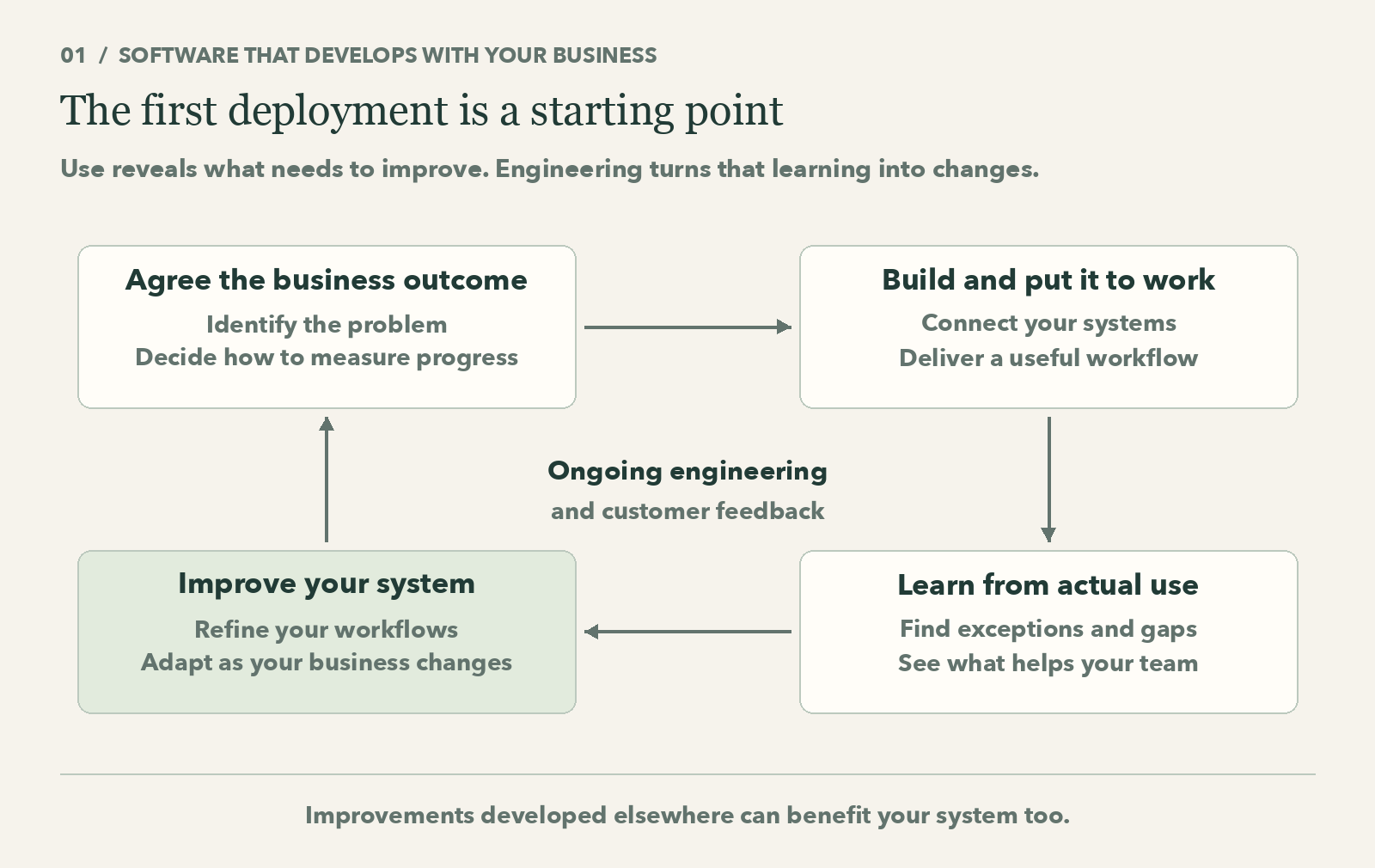
The initial deployment starts a cycle of use, learning and improvement.
Start with the outcome
The outcome-led approach is a core tenet of the work. Agreeing what you want to achieve gives the engineering its direction.
My co-founder Ben discussed his work with Ferrari at Palantir in a recent podcast interview. The team started with the 15 questions Ferrari wanted to answer but couldn't. Those included comparing downforce through a corner with earlier runs and understanding tyre degradation. The objective was a faster car, which gave the engineering a purpose and a way to judge whether it was useful.
They could have more than ten meetings before a pilot, speaking to different people to establish a clear business outcome. Putting engineers into an organisation was too expensive to proceed on enthusiasm alone.
Your team and the engineers should agree what success looks like and how you will measure it. That requires deeper alignment than buying a particular use case and getting help implementing it. The team must be willing to question the proposed solution and change the design as it learns, using the success criteria to guide those decisions.
Renaming a sales or customer-success team doesn't give it the ability or authority to build what your business needs. The people doing the FDE work must be able to make engineering changes and take responsibility for the solution once it is in use.
The reality behind the title
Another misconception is how practical the work is. It can involve visiting the factory floor, travelling to a regional centre for a ride-along or working through stacks of paperwork before there is usable digital data at all.
It can mean spending days with IT teams understanding how systems connect and why an apparently straightforward change hasn't happened already. People may have good reasons to be cautious. The spreadsheet you want to replace might contain years of knowledge about exceptions the official process doesn't mention.
Management can explain the objective and authorise change. The people doing the work can explain where things break and which workarounds keep things running. A team that only speaks to the people buying the software will miss a great deal.
Across departments, finance, operations and the commercial team can each see a different part of the same problem. Someone needs to connect those accounts before deciding what should change.
I would ask how engaged your FDEs are. Are they speaking to people throughout the organisation? Are they willing to travel and visit your sites? Will they do “desk sits”, sitting alongside employees to observe how they actually work? That is how you get beyond a surface-level account of the process.
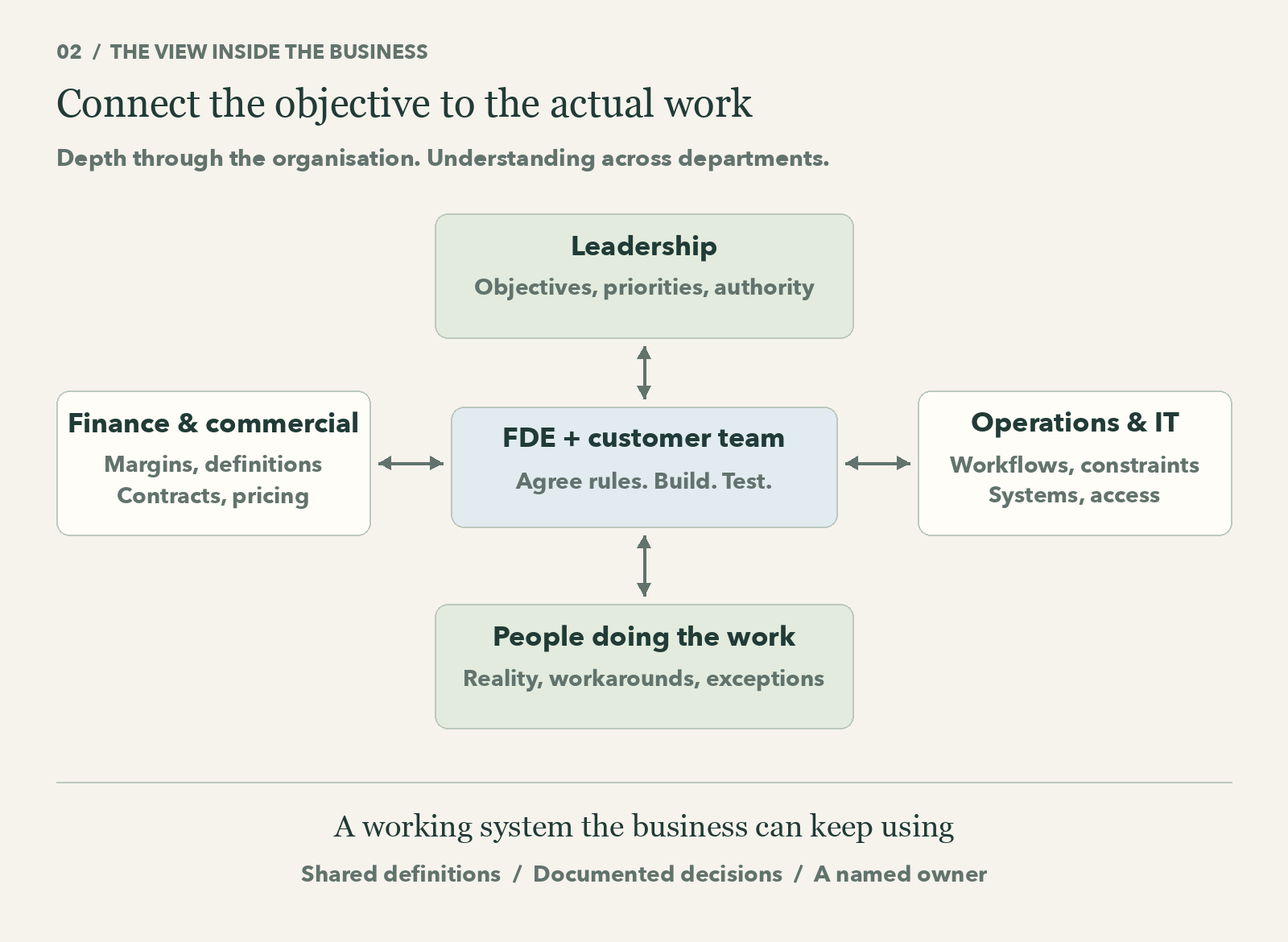
A company-wide view, with enough depth to understand the work.
Why the demand now?
The recent surge in demand makes sense when you consider what AI allows companies to build. Software has always required implementation. What AI changes, in my view, is how much of a company's work can now be rebuilt around its particular needs, and how quickly a small team can build it.
Agents will push this further. Work that humans do through familiar applications can be done through code: generating a presentation in HTML, or combining data through a SQL database query instead of spreadsheet lookups. A repeatable task becomes a small program whose steps the agent can run and check.
I think talk of the death of SaaS overstates the case. How software is packaged and paid for may change, and some products will be displaced. But software itself is going nowhere. I expect much more of it as an ordinary means of solving business problems.
A recurring report, a purchasing decision or the preparation for a meeting can each have a small amount of software behind it, tailored to the company. People can still receive a familiar document or use an ordinary interface; the machinery producing it changes.
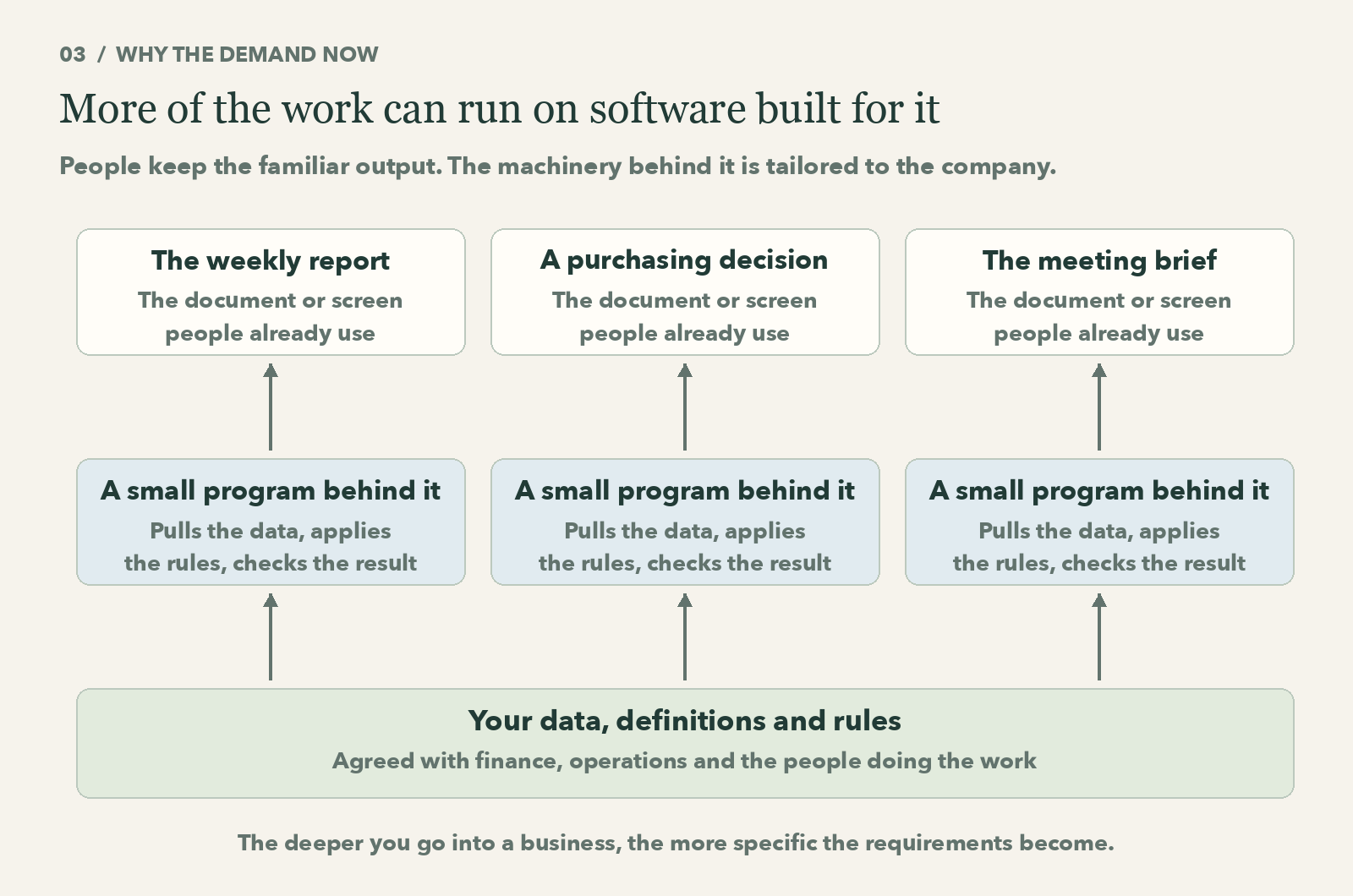
Familiar documents and decisions, with a small program behind each one.
The deeper you go into a business, the more specific the requirements become. Companies using the same accounting system can have very different purchasing rules and operating constraints. Faster building makes that customisation practical and understanding those differences more valuable.
Software engineers already had established ways of coordinating and checking changes when AI arrived. A process spread across finance, purchasing and a warehouse often has much less structure: several spreadsheets, a recurring meeting and one person who knows which numbers to ignore.
We discuss this regularly in our own deployments: different departments can have different interpretations of the same KPI, and agreeing what it means is part of the engineering work. Faster code doesn't resolve that disagreement for you.
This helps explain why AI companies need FDEs. Their technology can address more of a customer's work, but useful deployment depends on details that a standard product demonstration won't reveal. Someone has to discover those details, build around them and see whether the result gets used.
How to find the right FDEs
For a middle-market company, an external FDE team provides experienced engineering capacity without first assembling it internally. Smaller teams can now do more of this work, making the approach practical for businesses that couldn't support a large dedicated engineering team.
You also get an outside perspective, a part of consulting I think deserves more credit. Somebody can question an assumption that has become normal internally or recognise a problem another company has solved. The familiar frustration comes when recommendations are handed over and your team inherits an implementation project on top of its existing workload.
Plenty of consultants do build and deliver. I'd ask whether the people who understand the problem remain involved in making the solution work, including fixing what only becomes apparent once people use it.
For the engagement, I would treat that team as an extension of the business, with access to the people doing the work and a sponsor who can resolve disagreements. In return, expect a working capability and evidence of whether it improved the agreed outcome.
You don't need an FDE for every software purchase. If an existing product solves the problem with straightforward configuration, use it. The case becomes stronger when the problem crosses systems and departments, the requirements need discovering and someone has to build what is missing.
When assessing a team offering this, I would ask:
What business outcome will we agree on, and how will we measure progress?
Who will work with our frontline staff, and who will actually build and change the system?
What can those engineers change themselves, and what depends on the vendor's product roadmap?
How will the software improve after the first deployment, and what does that ongoing work cost?
What will our team be able to operate and maintain, and which licences or support will we continue to need?
I'd be cautious if discovery is confined to management meetings, the solution is fixed before anyone understands the operation, or every technical request goes to another team with no clear owner.
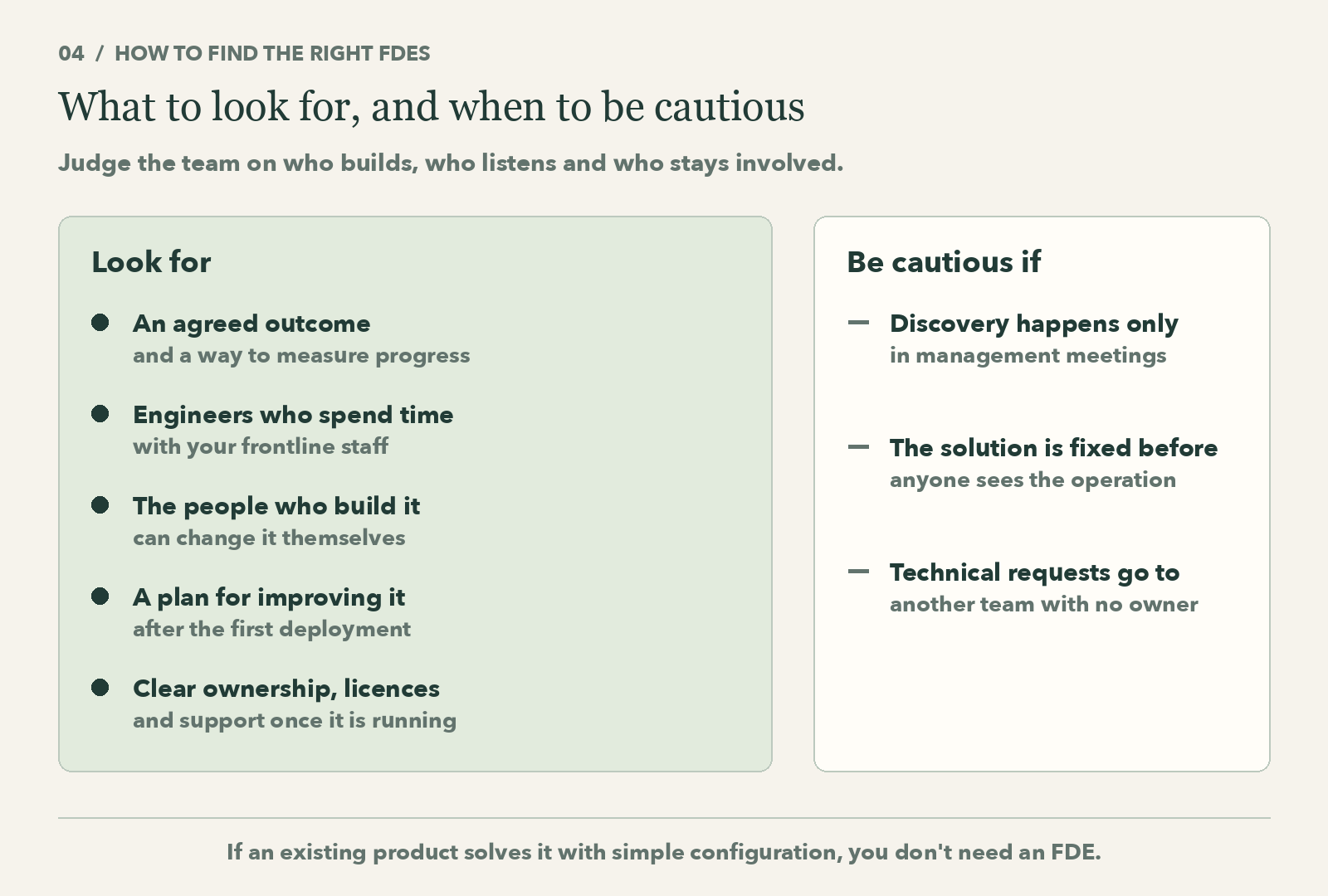
What to look for in an FDE team, and when to be cautious.
For a PE owner, the company's operating knowledge should become more usable. Definitions, rules and decisions developed during the engagement should remain available, making the next problem easier to solve.
At DealSage, the part I find most satisfying is when something we have built becomes an ordinary part of somebody's day. They have a job to get on with, and the thing that used to get in their way no longer does.
What The Builders Are Saying
This matches what I'm seeing in hiring. People who understand both the business and what the new tools can do are scarce, which is a big part of why FDE pay has gone where it has. The more capable the AI gets, the more the human judgement around it is worth.

Agreed, and I'd add a step before it: check whether the process needs to exist at all. Plenty of work only exists because of the limits of the old tools, and automating it just makes the unnecessary part faster.

I agree, and wrote about it last week. AI speeds up the building and there are more people offering to help, but organisational change still moves at the pace of the organisation. I'd plan in years while expecting gains from individual deployments much sooner.

News Digest
Nvidia loses its founder
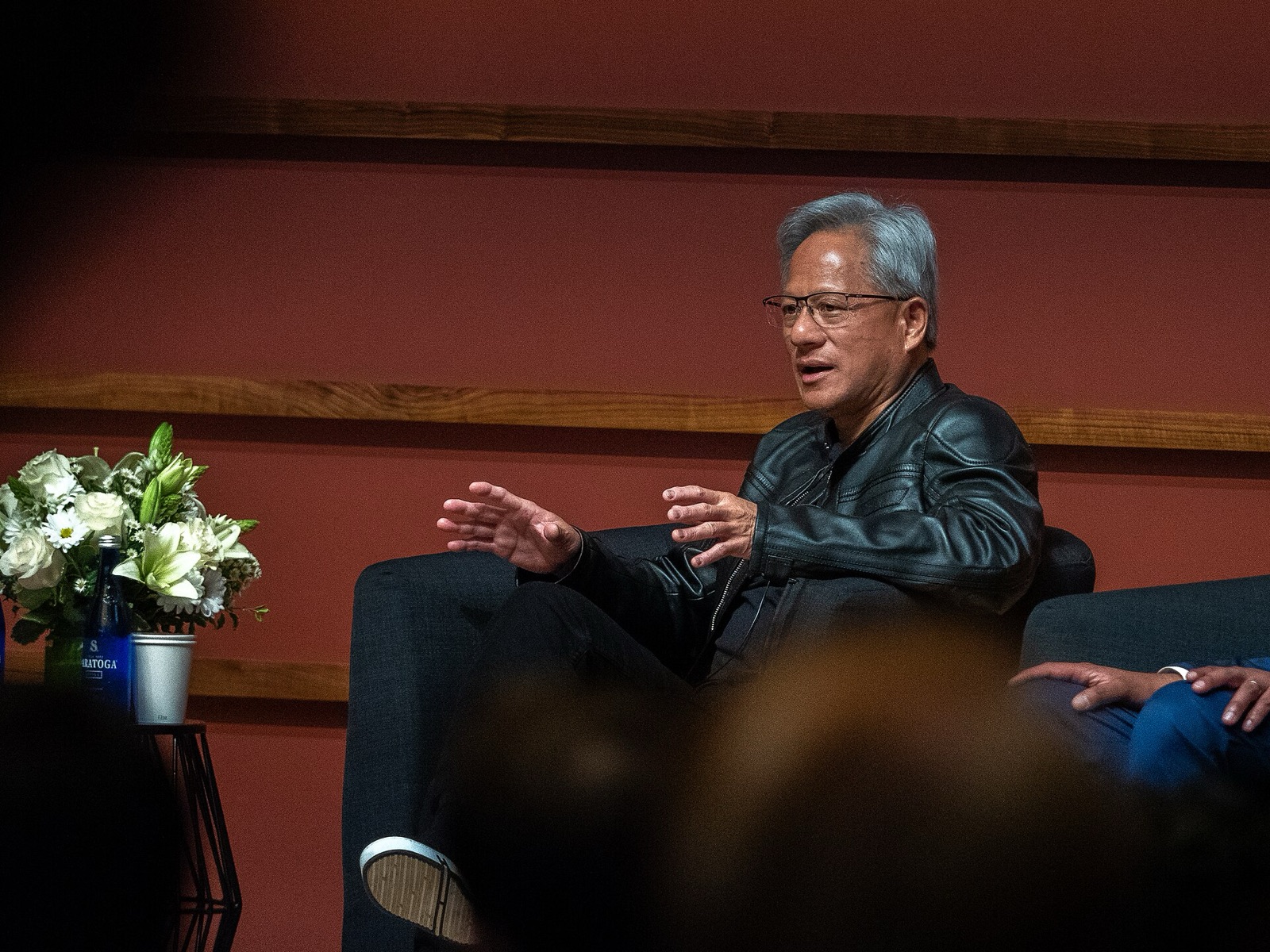
Jensen Huang at Stanford in April. Photo: Anders Eidesvik, CC BY 4.0.
Nvidia announced on November 12 that Jensen Huang had resigned as president, chief executive and a director, effective immediately. The company's statement gave no reason. CNBC reported that he stepped down after two extramarital affairs became public, one of them with an alleged Chinese spy. The board has started a search for a permanent successor, five days before the company reports its third-quarter results.
The details:
Colette Kress, the finance chief, becomes interim chief executive and keeps her existing job.
Harvey Jones was appointed the first chair of the board in Nvidia's history.
The shares fell 13% over the week, a sixth weekly decline in a row and the longest run since 2012.
About $1.7 trillion of market value has gone since the slide began in early October.
Results are due on Tuesday, November 17.
What This Means: Nvidia sits underneath most of the AI buildout, and for 33 years it has had one person at the top. Investors now have to work out how much of the company's position depended on him, in a market that was already nervous about the pace of the buildout.
My Take: There's enough commentary on this already, so I'll keep mine short. Jensen Huang has clearly done an extraordinary job, and his absence concerns me. This whole AI trade is enormously important and, as the last few weeks have shown, precarious. Seeing it through is going to take the best and brightest we have.
Anthropic's IPO finds its buyers

Last week investors were pushing for a lower valuation and questioning whether Anthropic could list in November. This week Bloomberg reported orders for around six times the shares available. The company is offering 825 million Class A shares at $70 to $78 each, which values it at up to $1.4 trillion. Trading is expected to start on Nasdaq on November 19 under the ticker ANT.
The details:
Anthropic and existing shareholders are seeking up to $64.4 billion through the IPO.
A separate private placement adds $26 billion.
The $1.4 trillion top end sits below the $1.5 trillion some investors called the high end a week ago, and well below earlier talk of $2 trillion.
TSMC's board approved up to $500 million for Anthropic shares at the IPO price on November 10, and up to $500 million for OpenAI preferred stock.
What This Means: There's plenty of demand for the shares at this price. The questions the S-1 left open, about spending commitments and how quickly customers can absorb the technology, are still there for whoever owns the stock on November 20.
My Take: I've written at length over the last couple of weeks about my concerns with the IPO and the challenges it has to overcome. The valuation has landed roughly where I expected. But as we used to tell companies when taking them public, the real test starts now: the quarterly updates. You've got one quarter to outperform.
Other Interesting Things I've Read or Seen This Week
SoftBank ordered more turbines than it could use (WSJ, November 10). It had reserved well over 13 gigawatts, against the roughly 20 gigawatts GE Vernova ships in a year, and took a $3.7 billion hit cancelling the excess. This is what over-ordering looks like when the plans change, and I doubt it's the last write-off of its kind.
Banks are insuring their data-centre loans (FT, November 11). Lenders are passing 20 to 50 per cent of a loan's exposure to insurers, and giving up 50 to 70 per cent of their margin on that portion to do it. I read that as banks that are already full and still don't want to say no.
Cognizant has put more than 25,000 people on Claude delivery (November 10). The new group will build and run Claude systems for clients under a managed services model. The headcount tells me less than I'd like. I'd ask how many of them will work alongside my team, and who holds the knowledge once the system is running.
BILL says its agents save about eight people's worth of hours (PYMNTS, November 5). Its risk team has built more than 100 agents, saving over 1,400 hours a month. The figure I'd look at is the other one: customers on an underwriting case now wait about 12 minutes instead of three hours.
AI is coming for managers' headcount (FT, November 8). McKinsey has agents in wide use at 40% of companies with $1 billion or more in revenue and 22% of smaller ones. Pilita Clark also points out that agents fail silently where other software crashes, so I'd decide who checks them before deciding how many to run.
Oura is paying $625 million in cash for an AI primary-care company (WSJ, November 10). Oura's revenue grew 92% to about $1.75 billion last year, and its own IPO is on hold. A ring maker buying its way into care delivery tells you where it thinks the margin will be.
The FT on what Huang's exit says about human judgment (FT, November 15). Emma Jacobs asks how a company that valuable, with no chair, became so dependent on one man with no clear succession plan. It's a fair question for any founder-led business, including the ones in a PE portfolio.
A failed upgrade took Microsoft email down for 19 hours (WSJ, November 14). About half a billion people lost email on Thursday, and one company had to move its earnings call. I'd ask what the business does for a day without it before adding agents that depend on the same supplier.
Know someone who'd find this useful? Forward this email, or send them your share link. Most new readers come from a friend passing it on.
Acquisition Intelligence is a weekly newsletter on how mid-market companies put AI to work, for operators and the investors who back them.
If you're working through any of these problems, reply. I'd be interested to hear where you're getting stuck or what's working.
P.S. I'm Harry, co-founder of DealSage. Ben and I work alongside companies to understand the bottlenecks, get their data into a form they can trust and build AI into the work itself. If you're weighing up who should do that work in your business or a portfolio company, reply and we can compare notes.