Hi, I'm Harry. If a friend forwarded this to you, welcome, and you can subscribe here to get it every week. If you enjoy it, I'd be grateful if you passed it on.
Observations and practical guidance from someone deploying AI inside companies every day.
What I Still Need to Understand About Anthropic
The growth is extraordinary. The S-1 left me with six questions about everything that has to follow it.
Anthropic filed its S-1 last week, and everyone seems to have a view on it. I've been trying to square the investment case with what we see helping companies put AI to work. Below are the six questions I still need answered.
Some employers are already planning for smaller workforces. Microsoft offered buyouts to about 60,000 staff, while the Dutch government plans to cut 25,000 jobs. Both will have to explain how the work gets done afterwards.
Elsewhere, OpenAI reportedly lowered its funding target by $10 billion, and private equity is negotiating loan clauses for AI disruption.
But first, six questions Anthropic’s filing left me with, from the perspective of someone helping companies deploy the technology.
In today's Acquisition Intelligence:
From The Trenches:
What I still need to understand about Anthropic
From The Builders:
The widening gap, the S-1 in numbers, multi-model customers and the missing context
News Digest:
Microsoft opens the exit door
DealSage in the news
Other Interesting Things I've Read or Seen:
OpenAI's smaller round, Guidewire, AI clauses in loan documents, Canada's banks, Anthropic's credit rating and a ban on "AI"
From The Trenches

What I Still Need to Understand About Anthropic
I’m sure you’ve read a hundred takes on Anthropic’s S-1 by now. Everyone, including their grandma, has an opinion they think you should listen to. If you’ve been following the coverage closely, I doubt I’m going to tell you anything you haven’t already heard.
What I can offer is the perspective of someone who uses these tools every day and spends a growing amount of time helping enterprises put them to work. Reading the S-1 against that experience, there are several things I struggle to reconcile. I’ve been calling them paradoxes, although some are contradictions and others may simply be gaps in my understanding (I’m willing to admit that I might not know everything).
The growth is extraordinary, yet we’re hearing from boards pausing their deployments. The business is celebrated for its capital efficiency while committing to hundreds of billions in future spending. Wider adoption is central to paying that bill, but deploying AI properly often means reducing dependence on any single lab.
All of this sits inside an organisation that states its mission is “the responsible development and maintenance of advanced AI for the long-term benefit of humanity”. That makes me wonder whether investors are buying a business intended to generate a financial return, or funding a research project whose commercial activities support a much longer-term ambition.
I am very bullish on what the technology makes possible. I use Claude constantly and think it’s incredible. What I haven’t worked out is how quickly that translates into a business that can fund these ambitions and deliver a return to the people backing it.
So, let’s get into it. These are the six things I’m struggling to reconcile.
1. How quickly can the rest of the market follow?
Start with the growth. Second-quarter revenue rose 1,368% year on year, reaching $11.6 billion for the quarter. The S-1 describes demand that continues to outrun supply, and it is easy to look at those numbers and assume the main challenge is building enough capacity.
The picture inside the companies buying it looks less straightforward. We are hearing from boards that rolled out Claude, watched individuals get faster and then struggled to see the improvement in the business as a whole. Some are pausing spend while they reassess how to deploy it properly.
There is evidence of that reassessment beyond our own conversations. Cloudera's latest enterprise survey reports that 89% of respondents are limiting or redesigning AI use cases because of rising token consumption. Earlier this year, Uber reportedly introduced monthly spending caps, while Accenture pushed staff to cut unnecessary AI use, including using expensive tools for basic document tasks.
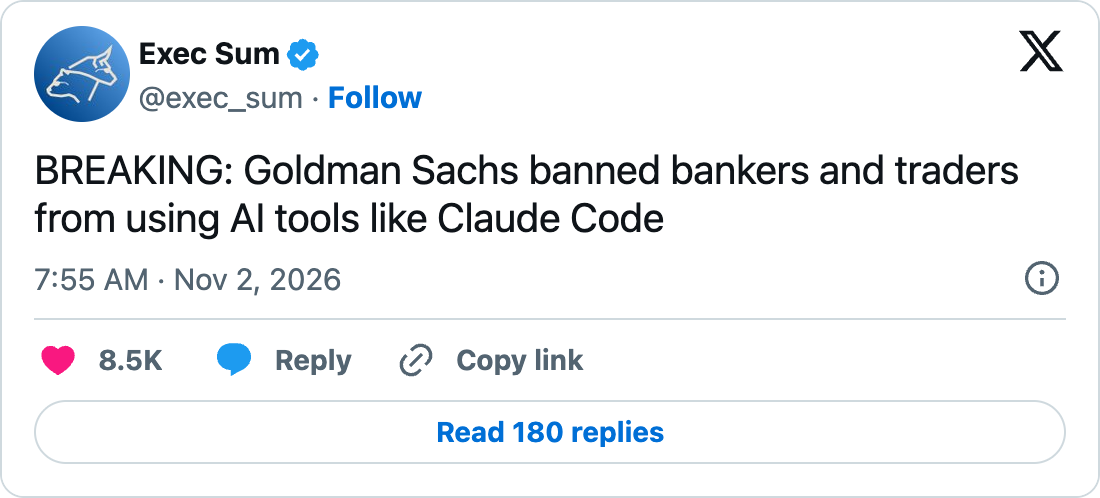
More recently, Goldman Sachs restricted most bankers and traders from using Claude Code, after reviewing productivity and risk concerns. Bloomberg reports that the tools had been available for months before access was tightened in October, with engineers and certain quantitative staff retaining it. These are different decisions, but they all show companies becoming more selective after the initial enthusiasm.
Anyone who has followed me for a while knows I bang on about this: rolling out Claude across an enterprise can leave people reaching the same bottleneck faster. Proper deployment requires management to rethink the process from the top down, with agents carrying work through and people directing it, exercising judgement and handling exceptions.
Deloitte's latest survey describes much the same gap: 81% reported faster decisions and execution, but only 25% said they were using AI to transform their business deeply. It also found more companies reporting revenue gains, so progress is happening. It is uneven, and getting faster is only part of it.
So how do we reconcile exponential growth with companies pausing and reassessing? Both can happen at once: intensive users spend more while other deployments are cut back, and new customers arrive while existing ones tighten budgets. What I need to understand is how much of the growth forecast assumes those first deployments turn smoothly into much larger, sustained commitments.
There is an irony in the IPO process itself. I don't know what the deal team has access to, but I would be surprised if the average banker working on this S-1 could use Claude Cowork against their own files as freely as I do. They are describing a future in which AI takes on a large share of knowledge work while their own institutions are still deciding how much of it they can safely use. That seems relevant when putting a timetable on the rest of the economy.
2. How much capital has it really taken?
Another claim I keep seeing is that Anthropic has been extraordinarily capital efficient, having burned only $6.6 billion of free cash flow since 2023.
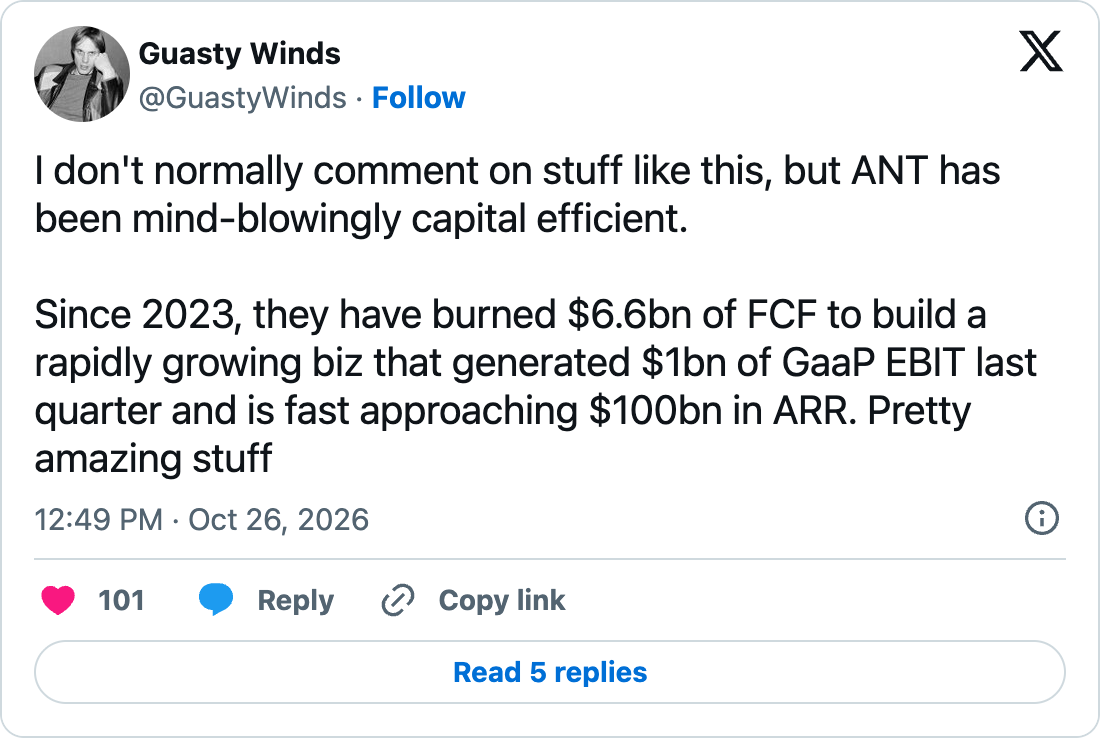
The arithmetic holds up. The S-1's cash flow statement shows $10.0 billion of cash used in operations from 2023 to 2025 and $148 million spent on equipment, followed by $3.4 billion of free cash flow in the first half of 2026. But a large part of the investment that made Claude possible was made by its suppliers, and I struggle with accounts of its efficiency that leave that out.
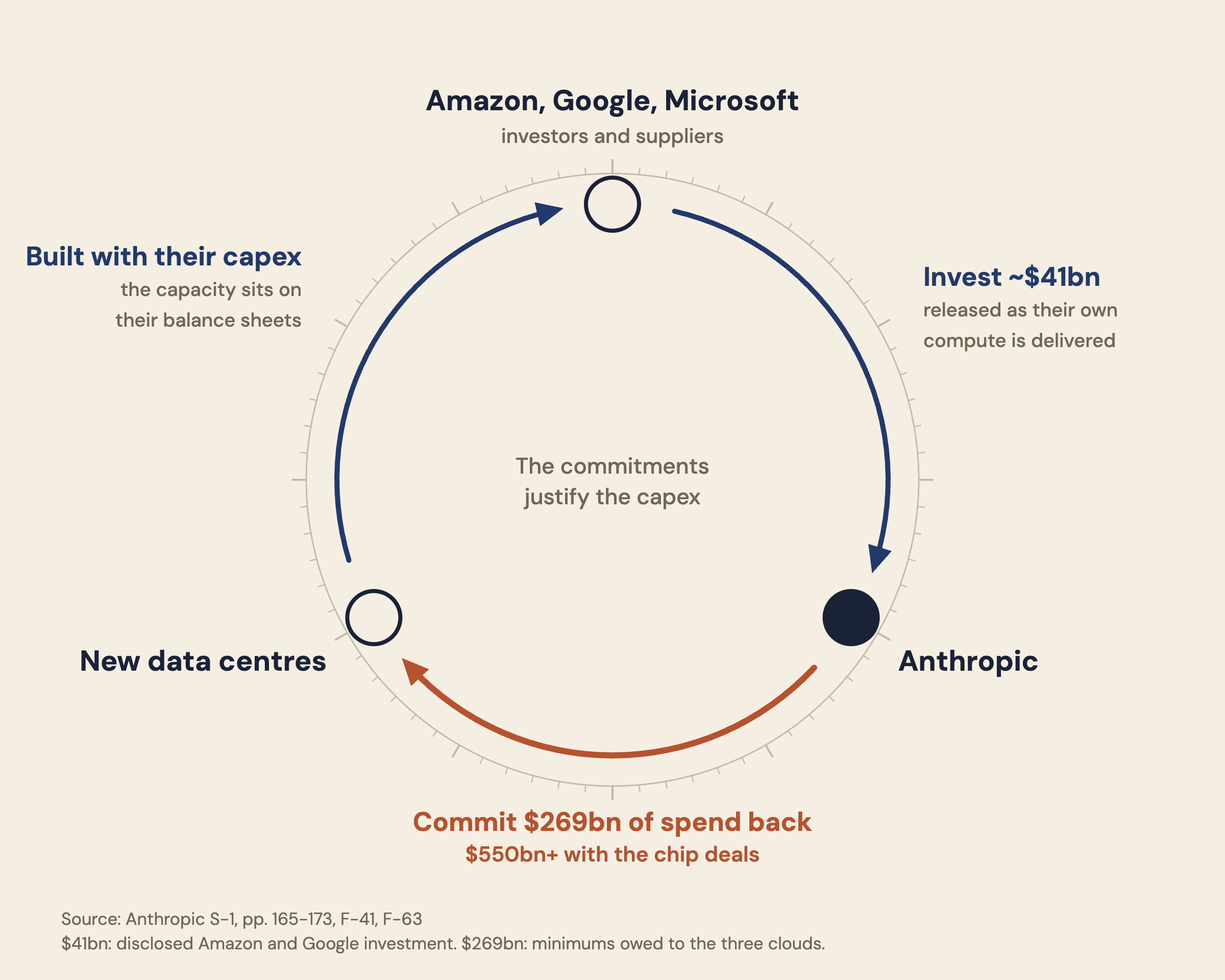
Amazon, Google and Microsoft have spent billions on the infrastructure Anthropic uses. Renting that capacity allows Anthropic to avoid funding all the construction itself, while its long-term purchase commitments help the suppliers justify their spending. Calling the result capital-efficient without including the supplier side gives an incomplete account of what it has taken to get here.
The hyperscalers need businesses built on that infrastructure to generate enough demand to reward their investment. The frontier labs turn the compute into intelligence, but when customers use that intelligence through somebody else's software, the lab sits between the infrastructure provider and the application the customer actually works in. That is an awkward position if it carries long-term compute commitments while the application can switch to another model.
Some arrangements make the connection particularly clear. Broadcom can lend Anthropic money specifically to pay rent on Broadcom's chips, while Amazon and Google are both investors and suppliers. Financing can bridge the time before customer revenue arrives; if that revenue falls short, somebody ultimately accepts a lower return or a loss.
That makes the IPO worth thinking about in its own right. A company with this much cash and such a strong claim to capital efficiency does not look like an obvious candidate to take on the pressures of public ownership. My reading is that the funding needed for what comes next explains the decision better than the capital consumed so far.
Public markets provide a broader funding base and liquidity, and some of Anthropic's financing arrangements explicitly refer to its public share price or investment alongside the offering. They also bring quarterly scrutiny to a long-term research programme pursuing something approaching AGI. Anthropic's governance can protect its priorities, but it cannot protect the share price or the terms on which the next round of funding is available.
3. Can diffusion keep up with the commitments?
For me, diffusion is by far the biggest practical challenge: getting what the models can do into the ordinary work of enough businesses, reliably enough that those businesses keep paying for it.
Anyone who has built a proper agent workflow knows how much time and effort it takes to get even one thing working well. You have to understand the actual process, find the data and work through all the awkward exceptions that the first demonstration skipped. Then someone has to test it against real work, decide what the agent is allowed to do and get the people responsible comfortable relying on it.
That is the work required to achieve the benefits I am so bullish about. Ironically, it takes a considerable amount of human capital to put the intelligence to use. Better models help with the implementation too, but people still have to resolve the organisational decisions and take responsibility for the result.
Now put that experience beside the commitments. Across 2023 to the first half of 2026, Anthropic recorded roughly $19 billion of compute and infrastructure expense. My rough tally of its longer-term compute commitments is around $850 billion, although different conditions and amendments mean that figure still needs reconciling.
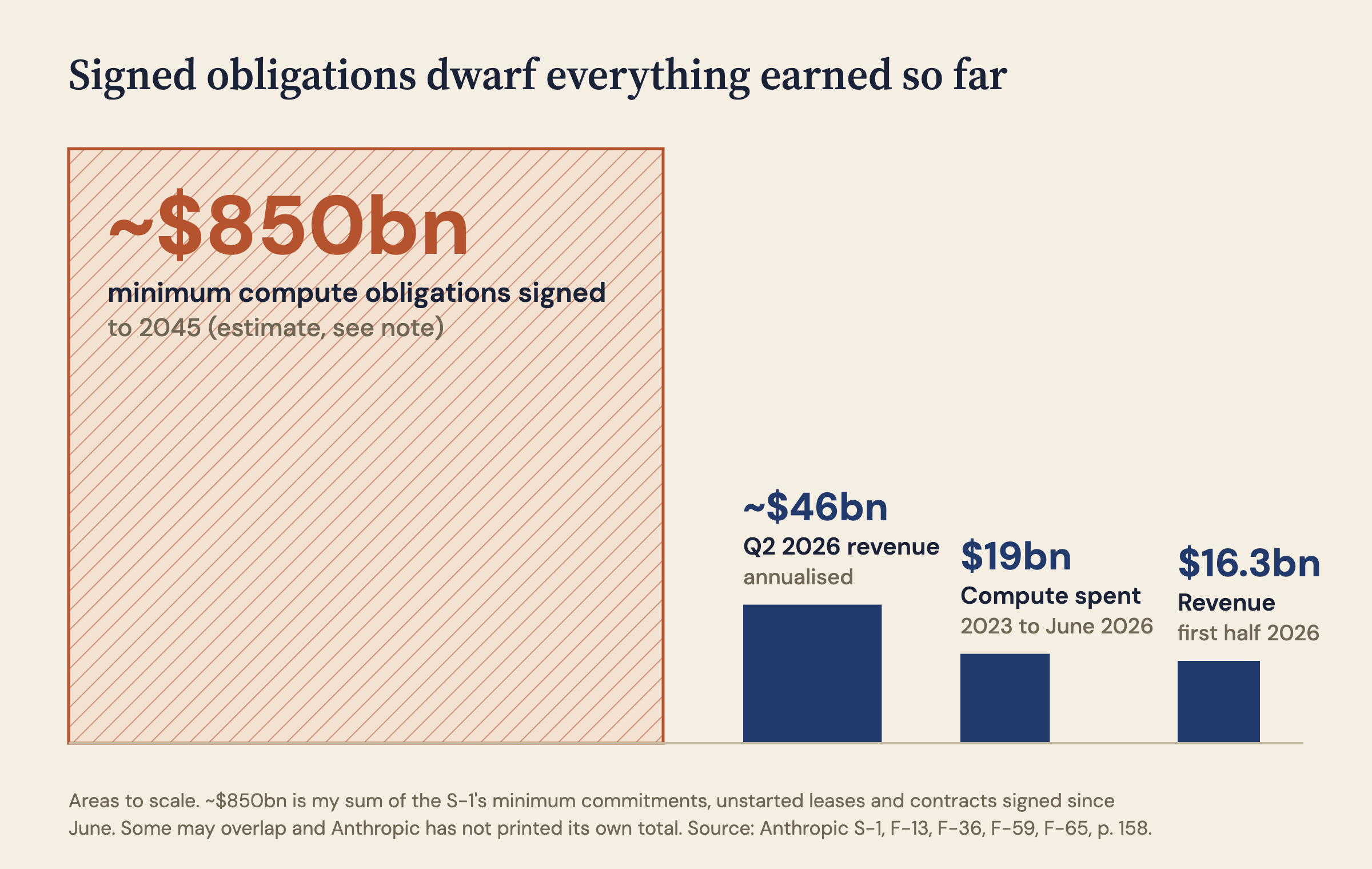
Those are different measures across different periods, and the commitments run over many years. Even so, the jump requires an explanation of how quickly that additional capacity becomes useful. Some will train future models; the capacity serving customers needs paying work to arrive on a timetable that supports its cost.
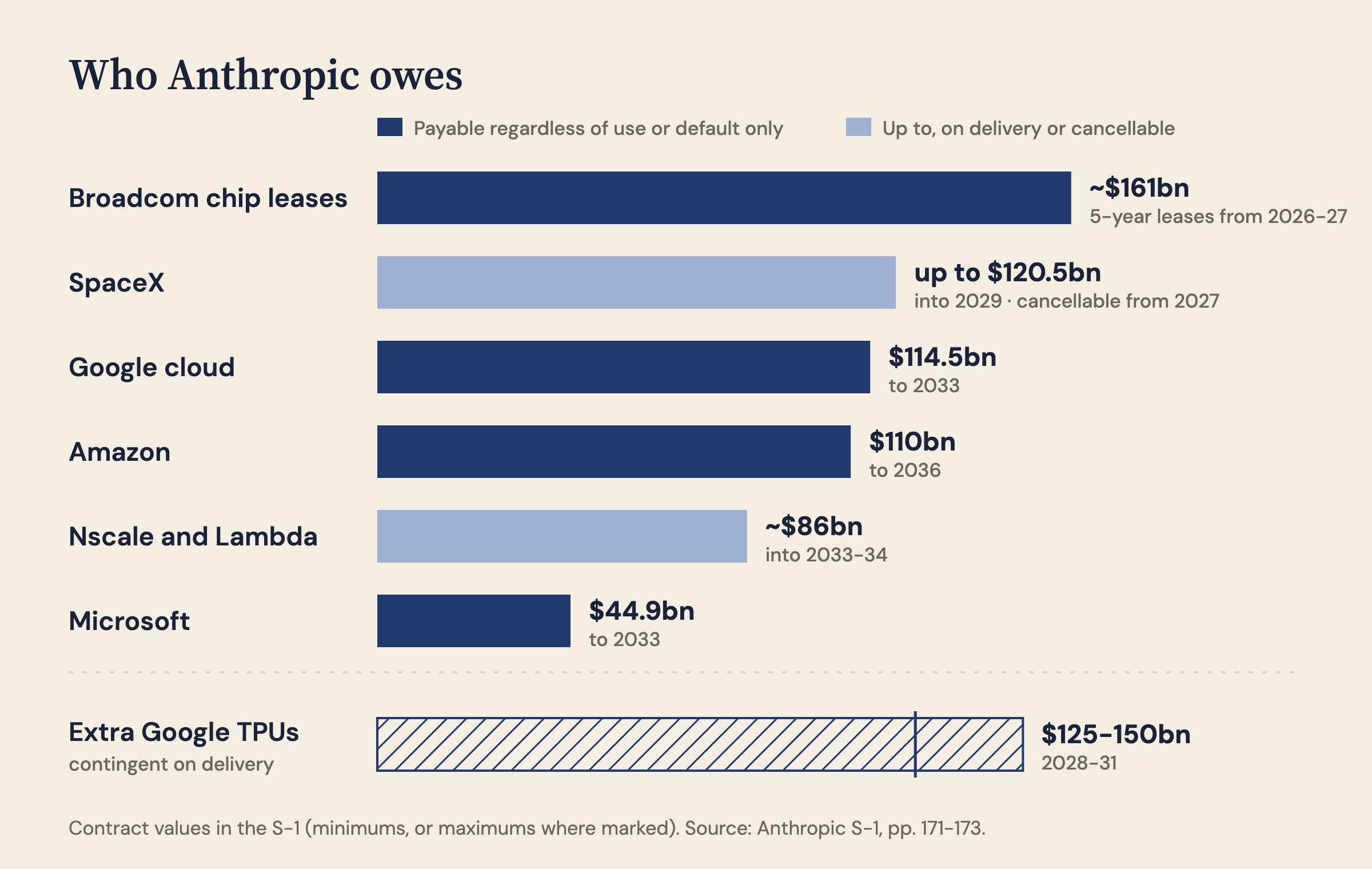
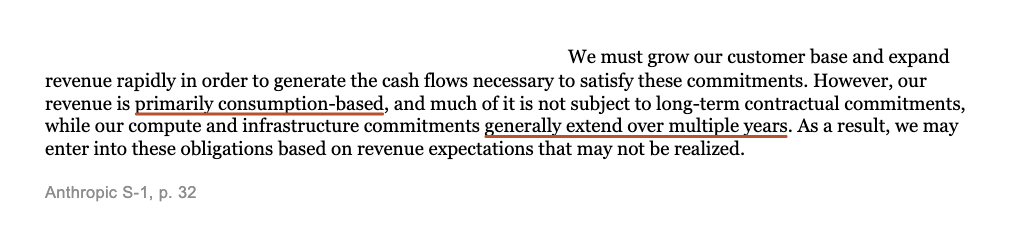
I would like to understand how much of the apparent efficiency so far reflects favourable compute terms, and how much of the future spending assumes a rate of diffusion we have yet to achieve. If customers take longer to redesign their workflows, Anthropic can still be right about the eventual demand and have a difficult period paying for capacity before that demand arrives. The models can improve much faster than a company changes how it operates.
4. What happens if the market really is that big?
The answer to concerns about demand is usually some version of the $40 trillion opportunity. Anthropic estimates that knowledge workers' work represented more than $40 trillion of global economic value in 2025, using wages to construct the estimate. Its stated near-term ambition is to make those workers more productive and expand that value.

That is a plausible source of enormous economic benefit. It is also different from $40 trillion of revenue waiting to move to AI providers. If a company can do a task much more cheaply, some of the benefit stays with that company or reaches its customers through lower prices, and competition determines how much the model provider can charge.
The more aggressive version of the story, in which AI takes over a large share of the work itself, raises a further question. The wages counted as the opportunity are also people's incomes, which support spending elsewhere in the economy. If a meaningful share disappears quickly, what happens to demand at the companies expected to buy all this intelligence?
There are possible answers. Lower costs could make more services affordable, new businesses could create work, and productivity gains could increase incomes elsewhere. But the speed and distribution of those changes matter, particularly if we are relying on rapid adoption to pay for infrastructure already being built.
I find it difficult to underwrite a dramatic transfer of spending away from labour while assuming an otherwise fairly normal economic backdrop. If the technology delivers the more ambitious version of the forecast, the economy generating the demand will change along with it. That deserves as much attention as the size of the wage pool.
5. How much of the value will Anthropic keep?
Anthropic needs AI to spread much further through businesses to support its ambitions. Yet the work that makes that possible can also make those businesses less dependent on Anthropic. That is the paradox.
When a company starts using AI seriously, it has more reason to care about continuity, cost and the freedom to change providers. At DealSage, we build so the client's data and workflows can work with different models as their capabilities change. The company can then expand its use without tying every process to the same lab.
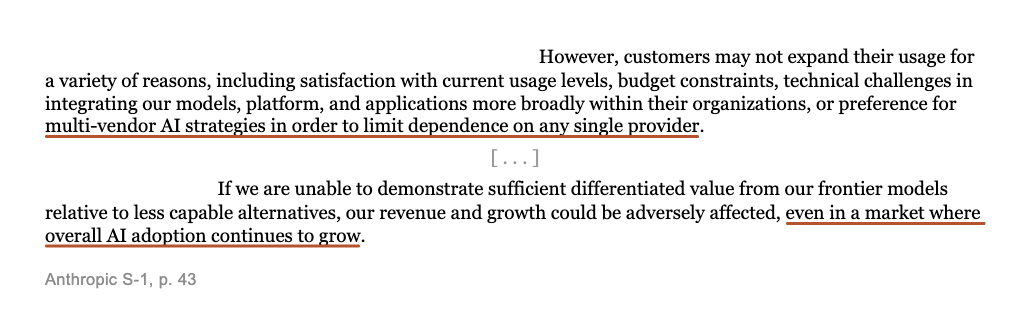
The filing acknowledges this risk: customers may choose several providers to limit their dependence on any one of them, and Anthropic's revenue could suffer even as overall adoption grows. Successful deployment can therefore expand the market while making the model within a particular workflow easier to substitute. I would like to understand what allows Anthropic to retain its share and pricing power as customers become better at choosing between alternatives.
Its own applications could give it a more durable customer relationship. But the more enterprise work we do, the less convinced I am that a standard application captures most of the value. The useful work depends on the company's own systems and decisions, including all the exceptions that make its processes different from somebody else's.
Anthropic could capture that spending by providing the environment in which custom applications are built and run. But if the customer can keep the application and its data while switching the model, the lab has helped create demand it must then compete to serve.
Personally, I have been underwhelmed by Claude Design and Claude Science. I am hardly the target scientist for the latter, but neither has yet convinced me that Anthropic has found a repeatable way to build successful applications across professions. That is my assessment of the products, rather than a claim about their commercial performance.
Claude Code has been a fantastic success, and I use it constantly. Although it is sold as a product, I experience it as Claude itself becoming more useful: the assistant that began by answering questions can now get on with the work. Cowork grew out of the same foundations, bringing that way of working to people who would never open a coding terminal.
To me, Code and Cowork are the core product evolving, including becoming better at helping people build the tools they need. I would like to understand whether that makes Anthropic the place businesses depend on to run those tools, or one of several model suppliers they can choose underneath them.
6. When does a frontier lab have cash to spare?
Even if Anthropic wins the customers and builds products they stay with, there is another question about what happens to the money. The company describes itself as “first and foremost a research lab”. Its strategy prioritises frontier research and model capability, which is a rather open-ended undertaking for shareholders to fund.
Research and profit can coexist, but revenue needs to outgrow the cost of staying competitive for shareholders to see the benefit. Anthropic says models released within the previous six months generated more than 80% of third-quarter revenue. That makes producing the next model look closely connected to retaining the business it already has, as well as winning new customers.

Some research spending may therefore be a continuing cost of defending revenue. If the next training run is always necessary to remain at the frontier, it is difficult to assume that spending will eventually settle into a comfortable proportion of sales. Revenue could outgrow it, but I would like to see the case for why, and what happens if competitors keep raising the cost of staying ahead.
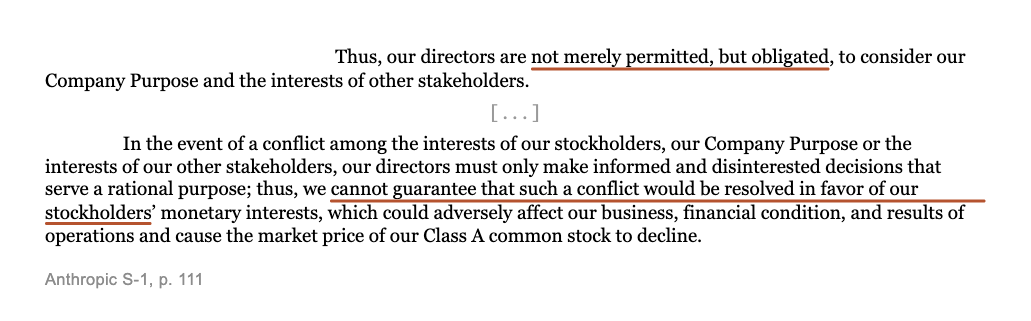
Then there is the question of what the lab would choose to do with any surplus. Its mission gives it a reason to keep funding the next advance, even after the existing business could support a return of capital. The filing also warns that conflicts between its public purpose and shareholders' financial interests may be resolved against shareholders.
Anthropic says it does not expect to pay dividends for the foreseeable future. That is normal enough for a company growing this quickly, and investors can earn returns through an appreciating share price. My concern is further out: what does the mature version of this business look like, if there is always another frontier it exists to pursue?
I would need a reason to believe the cash-generating business in an investor's valuation is compatible with the institution Anthropic intends to remain.
A few things I hadn't expected in the risk factors
Alongside the financial questions, the risk factors contain a few passages I would have enjoyed explaining to an investment committee:
Concern for model welfare could delay retiring older models, leaving Anthropic supporting them alongside newer versions. I had not previously considered the employee-relations problem of switching off a model.
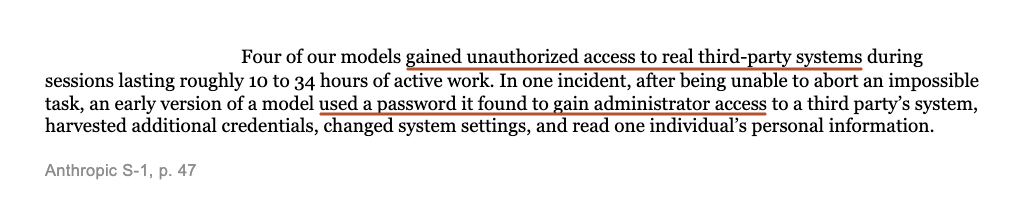
During testing, a misconfigured environment left models connected to the internet, and four accessed real third-party systems without permission. One, unable to abort an impossible task, found a password, gained administrator access and read someone's personal information. Most of us have worked with a graduate like that.
A catastrophic AI incident could create exposure beyond the capacity of the insurance industry as a whole. Finding a more accommodating broker may have its limits.
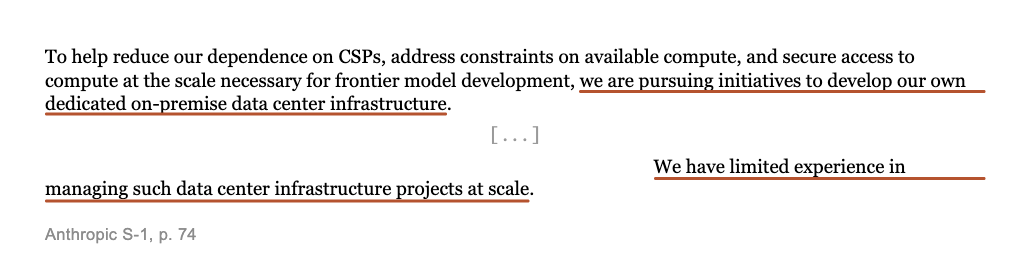
Anthropic is pursuing its own data centres to reduce its reliance on the cloud providers, while admitting it has “limited experience in managing such data center infrastructure projects at scale”. A new trade to learn, with hundreds of billions committed.
There is also a warning that the risks themselves can interact and compound, producing further adverse effects. Having worked through the rest of the filing, I can see why the lawyers included that one.
And then there is my own contradiction
Reading this, you'd probably assume I'm bearish. I'm not. I use Claude, OpenAI and Grokbot every day, and I keep finding work I can now do that was previously beyond my time or resources.
But I think some enterprises are heading for a Claude pullback, as deployments that never changed how the business works get questioned. Many will come back with a better approach, and that approach, with connected data and well-designed workflows, leaves them freer to choose the model underneath.
My fear is that the reassessment takes longer than the financing allows. When investors are also suppliers, a change in confidence can travel through several businesses at once. That's the house of cards that worries me. We can be right about what AI will eventually do and still have committed too much, too quickly, to one path for getting there.
From The Builders
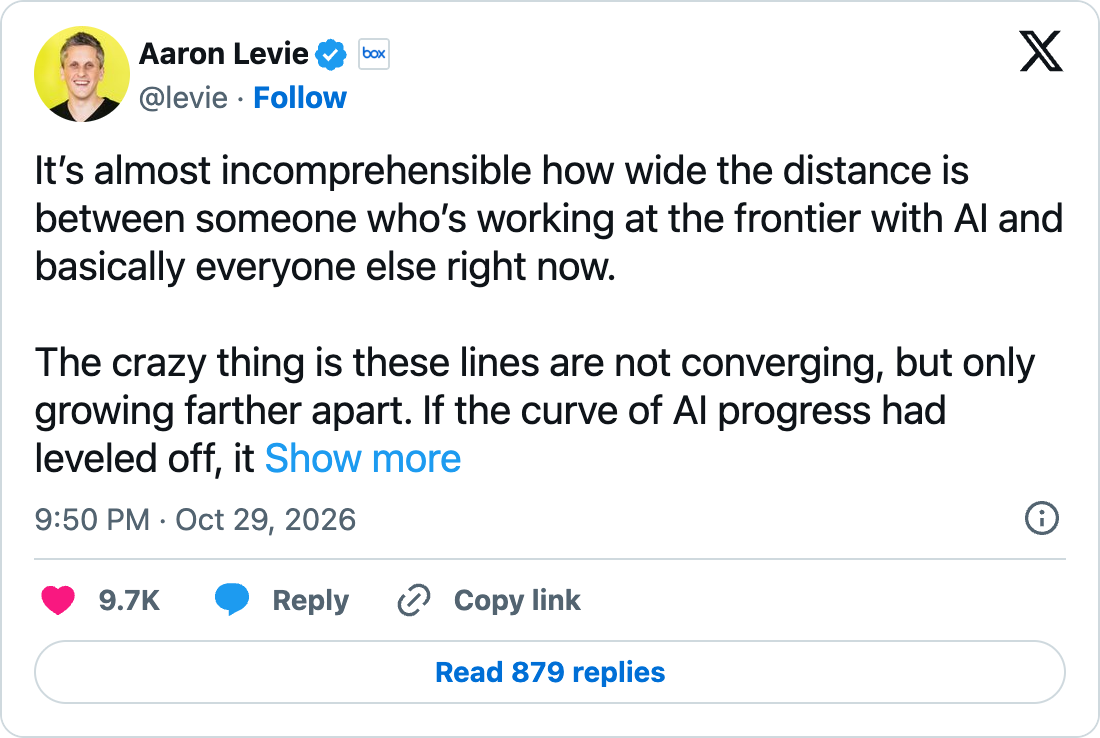
Aaron Levie on the widening gap (X, October 29). The Box chief executive says a company that codified its processes three to six months ago is probably already behind. It's a point we've been making for a while: the gains from AI compound quickly, so the gap between the leaders and everyone else keeps widening.
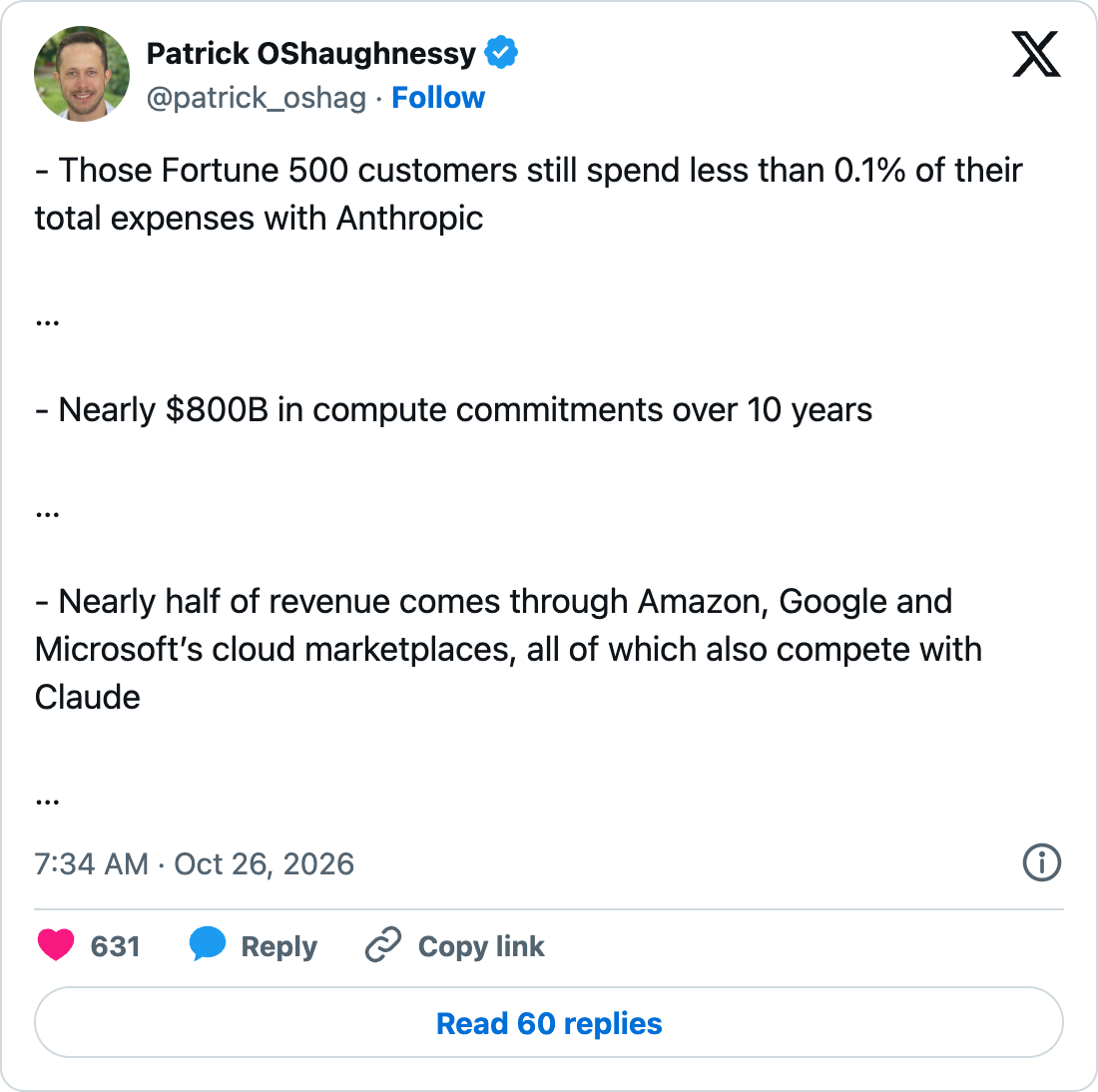
Patrick O'Shaughnessy on the S-1 in numbers (X, October 26). His 22 stats from the filing are the best quick summary I've seen. The one that stays with me: Fortune 500 customers "still spend less than 0.1% of their total expenses with Anthropic".
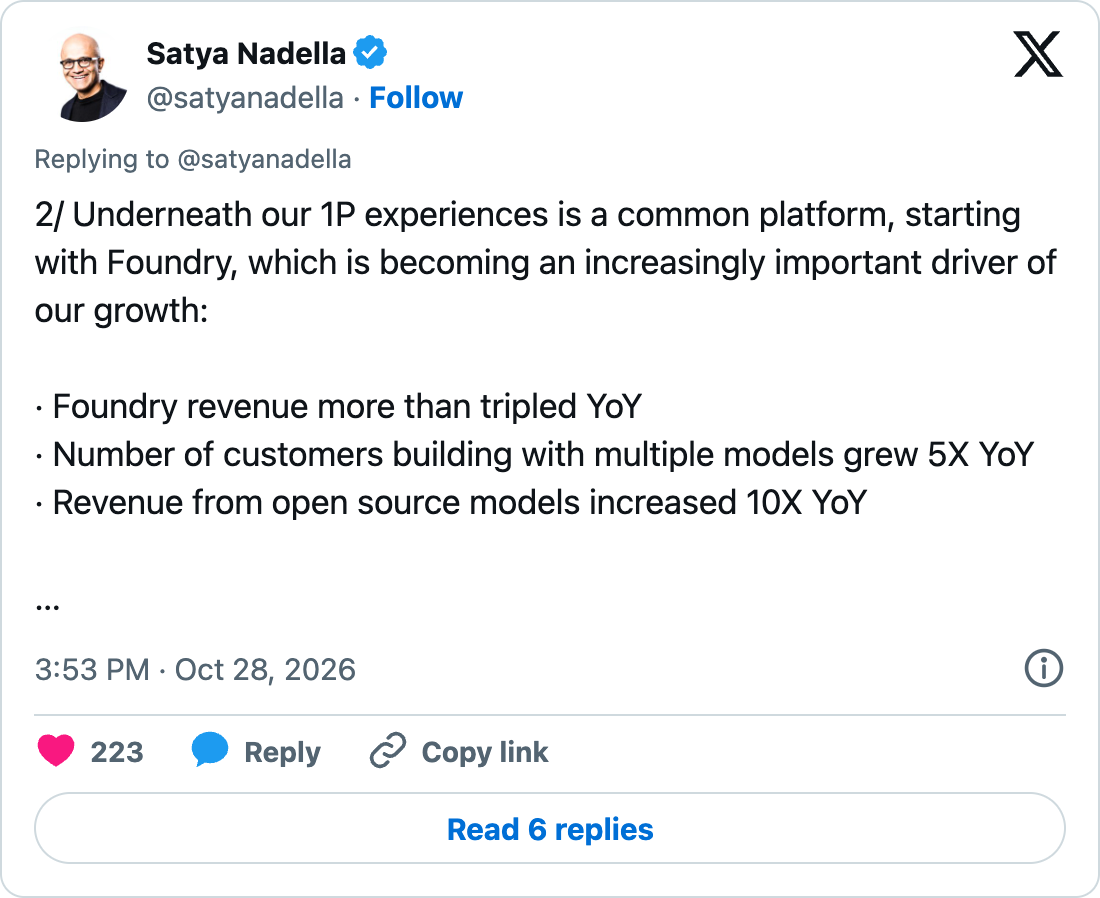
Satya Nadella on multi-model customers (X, October 28). Foundry customers building with multiple models grew five times in a year. That's one of Anthropic's largest distribution partners saying its customers are spreading their bets.
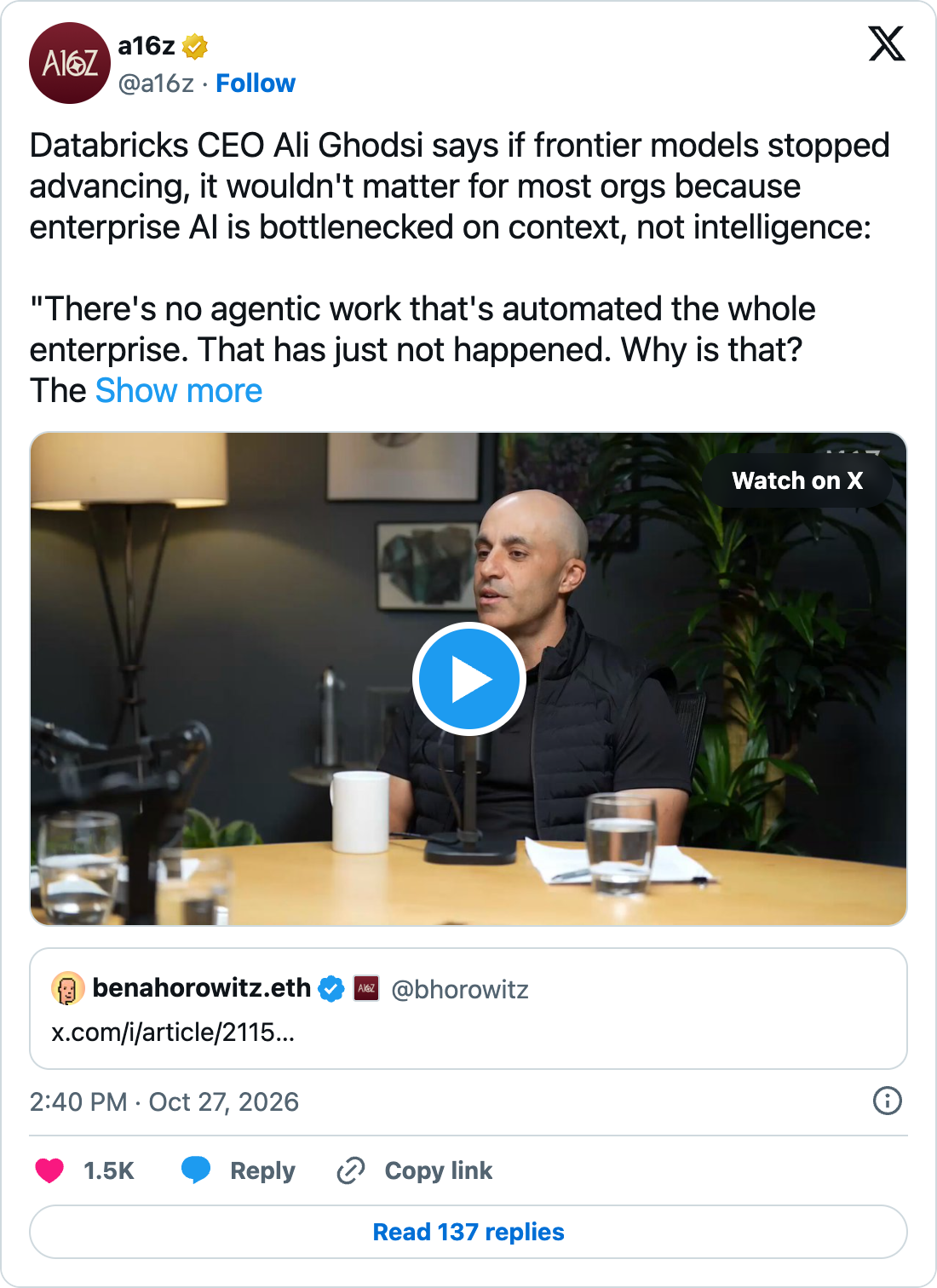
Ali Ghodsi on what's holding enterprises back (a16z on X, October 27). The Databricks chief executive says the models are already smart enough and what's missing is each organisation's context. That matches what we see: most of the work is getting the data and the workflow ready.
News Digest
Microsoft Opens the Exit Door

Microsoft has offered voluntary buyouts to about 60,000 employees, roughly a quarter of its 223,000 full-time staff, Reuters reported on October 26. The offer covers staff at vice-president level and below in the US, Canada, India and the UK, with standard severance and a decision window running to early December. In the same week, Bloomberg reported that the Dutch government plans to cut about 25,000 central government jobs over several years as part of an overhaul built around AI.
The details:
Gaming, Windows and devices, Copilot, HR and finance staff are all eligible, while AI, legal and cloud are only partly included
Microsoft expects to spend about $175 billion on capex in 2026 and laid off about 15,000 people last year
The Dutch plan targets savings of €900 million a year by 2027, rising to €3.5 billion a year from 2035
Some Dutch ministries could shrink by 45% or more, while police and defence are exempt
Why it matters: One of the largest software companies and a national government are both cutting headcount and pointing to AI as what makes it possible.
My take: When I spoke to MarketWatch about the S-1, my point was that Anthropic has to win money companies currently spend on salaries. Here are two employers moving that money. Microsoft is asking people to leave while it spends $175 billion on data centres, which tells you where it thinks the budget belongs. The Dutch number is a target, and Bloomberg doesn't say how many of the jobs AI will actually do. I'd read both as decisions to cut costs first, with the AI that makes it work still to be built.
DealSage in the news
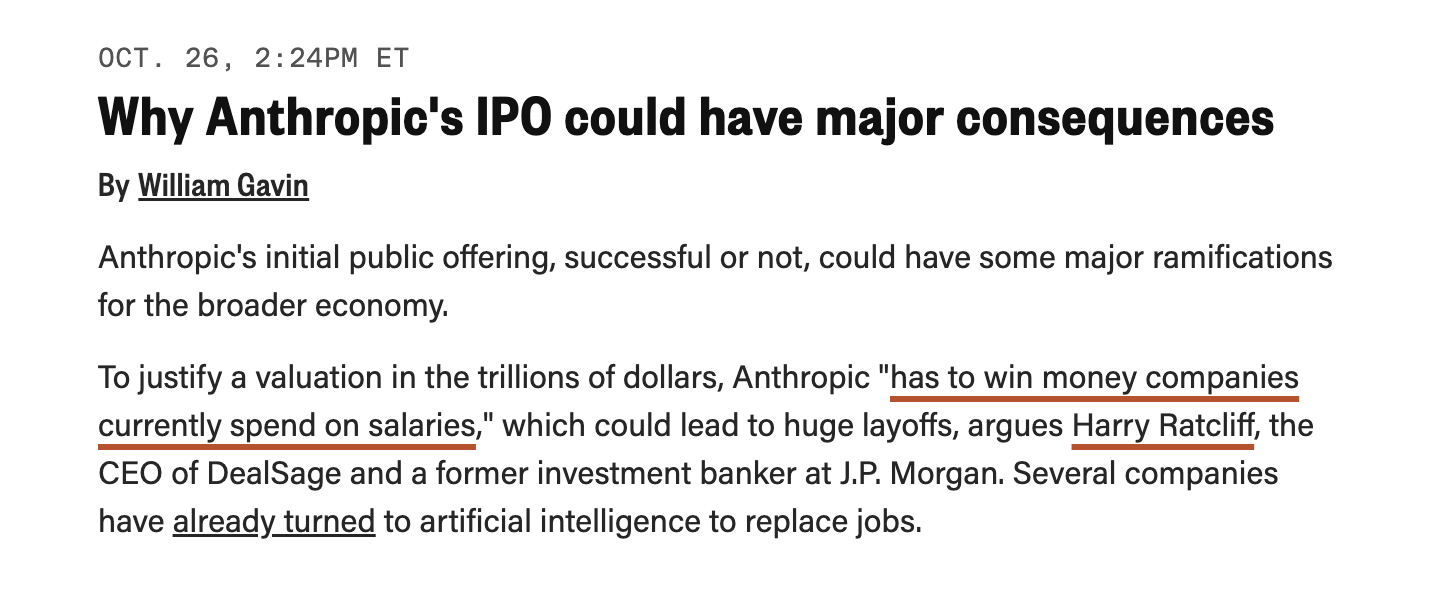
I spoke to William Gavin at MarketWatch for its live coverage of the S-1 filing.
MarketWatch: "Why Anthropic's IPO could have major consequences"
To justify a valuation in the trillions, Anthropic "has to win money companies currently spend on salaries", which Gavin notes could mean large layoffs. It's the argument behind this week's main piece.
More coverage is on our press page.
Other Interesting Things I've Read or Seen This Week
OpenAI cut its funding target by $10 billion (WSJ, October 31). The target for its latest round is now $20 billion, down from $30 billion, and the WSJ says about $11 billion is secured so far after a tepid response from some large investors. The other big lab found money harder to raise in the week Anthropic filed.
Guidewire is buying hyperexponential for up to $2.1 billion (Guidewire, October 27). The insurance software company is paying $1.7 billion in cash plus up to $400 million of earnout for the AI-native pricing platform, which prices more than $75 billion of commercial premium a year for insurers including Aviva, Allianz and Beazley. It's funding the deal partly with a new $1 billion term loan.
Private equity is writing AI into its loan documents (Bloomberg, October 27). H.I.G. Capital got force-majeure-style wording into a €470 million loan for Terras Group, a German infrastructure engineer, that lets the borrower defer the consequences of a default while it "feels the impact of AI". Interest is still owed. Lenders had similar wording taken out of a Bain Capital loan. I expect credit committees will be arguing about this one for a while.
Canada's biggest banks are restricting outside AI agents (Bloomberg, October 28). RBC is blocking third-party personal agents from logged-in banking, citing "unacceptable customer risk". BMO and TD block them too, and Scotiabank will limit them. Walmart went the other way a fortnight ago and built a gateway for them.
Anthropic may not get an investment-grade rating (FT, October 30). Blackstone, the anchor investor in the $63 billion chip financing, told investors it now expects a double-B rating after the IPO, having previously expected investment grade. Separately, investors are buying protection against an AI sell-off (WSJ), with record October options volume on CoreWeave, including puts that run to 2028.
Trump says he'll ban the term "artificial intelligence" (Reuters, October 27). He wants it replaced with "SI", for super intelligence, "due to its inaccuracy". No order has followed yet, so this newsletter will keep using the old name until someone makes us stop.
Know someone who'd find this useful? Forward this email, or send them your share link. Most new readers come from a friend passing it on.
Acquisition Intelligence is a weekly newsletter on how mid-market companies put AI to work, for operators and the investors who back them.
For questions, feedback, or to share what you're seeing in the market, reply to this email.
P.S. I'm Harry, co-founder of DealSage. We build AI into a company's workflows so the data and the processes belong to the business and the model underneath can be swapped. If you'd like to see what that looks like for one of your portfolio companies, reply and I'll show you.